

Furnace won't turn on? Troubleshooting tips before you call for repair
You walk downstairs, the house feels colder than it should, and the furnace is dead silent when it should be running. Before you call anyone, there are a handful of quick checks that solve a surprising number of no-heat calls without a technician ever setting foot in your basement.
Not every silent furnace means a broken furnace. Sometimes it is a thermostat setting, a tripped breaker, or a dirty filter that shut the system down as a safety measure. Other times, the problem points to something you should not touch yourself, like a gas supply issue or an electrical fault deep in the control board.
Older Philadelphia housing adds its own wrinkle to this. A furnace tucked into a tight basement mechanical room in a rowhome, a converted system in a twin in Northeast Philadelphia, or an older unit in a suburban home in Abington or Glenside can all fail for slightly different reasons depending on the age and layout of the system. The troubleshooting steps below apply broadly, but the age of your specific furnace and home matters when deciding how far to push a DIY fix before calling for help.
This guide walks through the heating repair troubleshooting steps worth trying first, explains what each one is actually checking for, and draws a clear line between "try this yourself" and "stop and call a professional." Working through it in order can save you a service call, or at least tell the technician exactly what you have already ruled out before they arrive.
In this article, you will learn about:
- The first checks to run before assuming the furnace is broken
- Thermostat and power issues that mimic a bigger problem
- Airflow and filter problems that shut a furnace down
- Warning signs that mean stop troubleshooting and call for repair
Keep reading to work through the checks in the right order, so you are not guessing in a cold house.
Start with the basics before assuming the worst
A furnace that will not turn on is rarely the mystery it feels like at 6 a.m. in January. Most no-heat calls trace back to one of a handful of common, fixable causes, and working through them in a logical order saves time and rules out the simple stuff before anyone assumes a major repair is coming.
The goal of this first pass is not to fix anything complicated. It is to confirm the furnace is actually getting power, actually being told to run, and actually able to draw air through the system. Skipping straight to worst-case thinking, like a dead heat exchanger, before checking these basics is how a five-minute fix turns into an unnecessary emergency call.
- Confirm the thermostat is calling for heat. A thermostat set to "cool" or "off" by accident, or one with dead batteries, will not send a signal to the furnace no matter how cold the house gets.
- Check that the furnace switch is on. Most furnaces have a wall switch nearby that looks like a light switch, and it is easy to bump off during basement work or storage.
- Look at the breaker panel. A tripped breaker cuts power to the furnace entirely, and a flipped switch that looks "on" but is actually stuck mid-position can fool a quick glance.
- Check the filter. A filter clogged with enough dust and debris can restrict airflow badly enough that the system's safety controls shut the furnace down before it overheats.
Working through these four checks takes less than ten minutes and resolves a meaningful share of no-heat calls before anything more involved is needed.
The most commonly overlooked switch
One check gets skipped more than any other, mostly because it is easy to forget it exists: the furnace service switch, a separate power switch mounted on or near the furnace itself that looks and functions like a standard wall light switch. It exists specifically so a technician can safely cut power to the unit during service without going to the breaker panel.
This switch gets bumped more often than people expect. It often sits near a basement light switch, a laundry room switch, or a storage area, and anyone reaching for a different switch in a dim basement can flip it by accident without noticing. Because it looks so ordinary, it rarely makes anyone's mental list of things to check when the furnace stops working.
- Look for a switch on or near the furnace cabinet itself, sometimes on the side of the unit, sometimes on a nearby wall or ceiling joist.
- Confirm it is fully in the "on" position, not stuck at a midpoint, which can happen with older toggle-style switches.
- If the switch was recently near any basement cleaning, storage, or other work, that timing is worth noting.
A missed service switch is one of the fastest fixes in this entire guide once you know to look for it, and it costs nothing but a few extra seconds of checking.
Why order matters when troubleshooting
Checking things in a specific sequence matters more than it might seem, because some symptoms overlap. A furnace that will not ignite can look identical whether the cause is a thermostat problem, a power problem, or an airflow problem, and jumping around randomly wastes time and can mask which fix actually worked.
Start with the thermostat because it is the fastest check and rules out the most common false alarm: a system that was never actually told to run. From there, move to power, since a furnace with no electricity cannot do anything regardless of what else is wrong with it. Airflow and filter checks come next because they affect whether a furnace that does have power and a signal can actually complete its startup sequence safely.
- Confirm the thermostat is set correctly and has working batteries.
- Confirm the furnace has power at both the wall switch and the breaker.
- Confirm the filter is not so clogged that it is restricting airflow.
- If all three check out and the furnace still will not run, move on to the more specific checks below.
Following this order also gives a technician useful information if you do end up calling for service. Being able to say "I checked the thermostat, the breaker, and the filter" immediately narrows down what they need to look at first.
What a working system should sound and feel like
Knowing what normal operation looks like makes it easier to spot when something is actually wrong versus when the system is simply cycling through its normal startup sequence, which can take longer than people expect.
A healthy gas furnace typically goes through a sequence: the thermostat calls for heat, the inducer motor kicks on first (often a quiet whir), the igniter glows or clicks, the gas valve opens, the burners light, and only then does the blower motor start pushing warm air through the ducts. This entire sequence can take 30 to 90 seconds depending on the furnace model, and a furnace that seems "dead" for the first minute may simply be working through its normal startup.
- A furnace that hums or clicks but never fully starts is signaling a stalled step in that sequence, not necessarily a dead system.
- A furnace that runs the blower but never produces warm air is a different problem entirely, usually pointing toward the burners or gas supply rather than the blower itself.
- A furnace that starts, runs briefly, then shuts off (short cycling) is often a safety control doing its job in response to something else going wrong, like restricted airflow or overheating.
Understanding which stage of that sequence is failing helps narrow down whether the problem is likely something simple or something that needs a professional.
Thermostat and power problems that mimic bigger issues
A surprising number of "my furnace is broken" calls turn out to be thermostat or electrical issues that have nothing to do with the furnace itself. These are also the checks most homeowners can safely handle without any risk, which makes them worth ruling out thoroughly before assuming a mechanical failure.
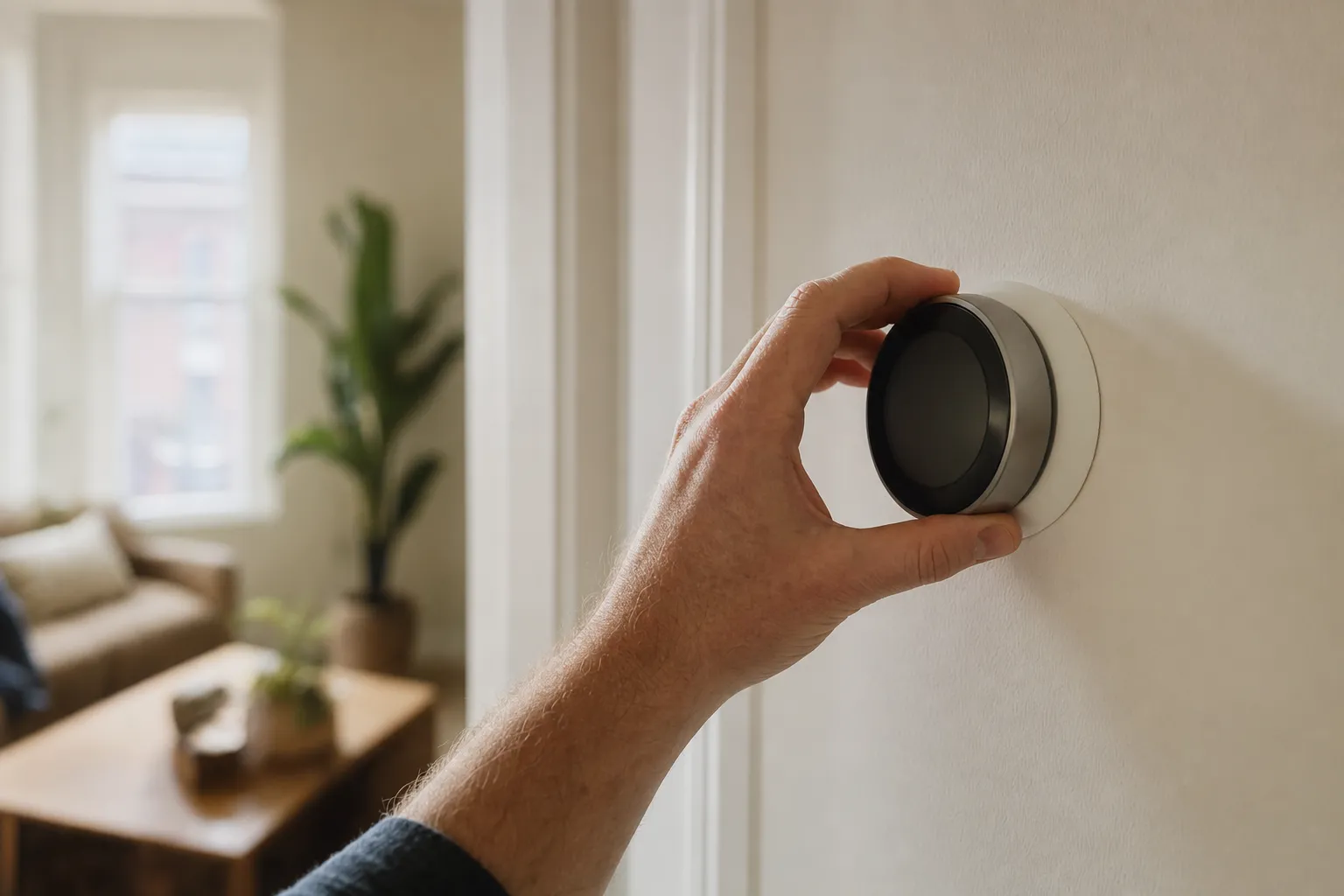
Smart and programmable thermostats add another layer, since a scheduling error, a dead backup battery, or a Wi-Fi connectivity issue on a smart thermostat can all prevent a heat call from reaching the furnace even though the thermostat display looks normal at first glance.
Thermostat settings and battery issues
The thermostat is the furnace's brain, and a brain that is not sending the right signal means the furnace never gets the instruction to run, regardless of how well the mechanical components are working.
- Confirm the mode is set to "heat," not "cool" or "off," since these settings are easy to bump accidentally, especially with a manual dial thermostat.
- Confirm the target temperature is actually set above the current room temperature, since a thermostat will not call for heat if it thinks the room is already warm enough.
- Replace the batteries if the display is dim, blank, or behaving erratically, even if it still shows a reading.
- On a smart thermostat, check the app or device for a scheduling conflict, a vacation mode left on, or a lost connection to the furnace's control board.
A thermostat issue is one of the easiest problems to rule out and one of the most common causes of a "dead" furnace, so it is always worth double-checking even if you are confident the settings are correct.
Electrical and circuit breaker checks
Furnaces run on standard household electrical power for their blower motor, control board, and igniter, even in gas models, which means an electrical interruption anywhere in that chain can stop the whole system.
A tripped breaker is the most common electrical cause of a furnace that will not start, and it can trip for reasons that have nothing to do with the furnace itself, like an overloaded circuit shared with other appliances. Resetting it once is a reasonable troubleshooting step. A breaker that trips again immediately after resetting is a sign of an actual electrical fault, not a fluke, and should not be reset repeatedly.
- Locate the breaker panel and find the breaker labeled for the furnace or HVAC system.
- Check whether it is in the tripped (middle) position rather than fully on or off.
- Switch it fully off, then fully on again to reset it.
- If it trips again within a few minutes, stop resetting it and treat this as an electrical problem that needs a professional, since repeated tripping usually means a short or an overloaded circuit.
The furnace's own wall switch deserves a second look here too. It is easy to assume it is on simply because no one remembers turning it off, but a bumped switch during basement storage, cleaning, or other work happens more often than people expect.
Age of the system and repeated electrical faults
An electrical fault that keeps recurring on an older furnace often points to a bigger issue than a single failed component. Furnace control boards, blower motors, and igniters all age, and wiring insulation itself can degrade over years of heat cycling inside the furnace cabinet. This shows up especially often in older housing stock, from rowhomes in Fox Chase and Mayfair to twins in Elkins Park, where original wiring has sometimes never been fully updated alongside newer HVAC equipment.
A furnace nearing the end of its typical service life is more likely to develop electrical faults that mimic each other, which makes a repeated breaker trip harder to diagnose without opening the unit. A homeowner troubleshooting from outside the cabinet has no reliable way to tell whether a specific trip is a one-time fluke, a failing blower motor drawing too much current, or a wiring issue building toward something worse.
- A furnace under a few years old with a first-time breaker trip is more likely dealing with an isolated issue, like a temporary overload from another appliance on the same circuit.
- An older furnace with repeated trips over weeks or months is more likely dealing with a genuine internal electrical fault that needs a proper diagnostic.
- Either way, repeated resets without addressing the underlying cause risk turning a contained electrical issue into a bigger one.
This is one of the clearest points in the troubleshooting process where continuing to reset the breaker yourself stops being a helpful step and starts being a delay on a fix that actually needs a technician's tools to diagnose properly.
Airflow, filters, and ignition problems
Once thermostat and power issues are ruled out, airflow and ignition are the next most common categories of no-heat problems. These sit in a middle zone: some are safe and easy for a homeowner to check, while others cross into territory that needs a professional, particularly anything involving the gas supply or an open flame.
Restricted airflow is worth taking seriously beyond just "the house feels less warm." Modern furnaces have safety switches specifically designed to shut the system down if airflow is too restricted, because forcing a furnace to run without adequate airflow risks overheating the heat exchanger, which is both a performance problem and, in worse cases, a safety one.
The CDC notes that at least 15,000 Americans suffer unintentional, non-fire-related carbon monoxide exposure each year, a reminder that airflow and venting problems around fuel-burning equipment are a safety issue, not just a comfort one.
Filter and airflow restrictions
A clogged filter is one of the single most common causes of furnace problems across every category, from reduced efficiency to complete shutdowns, and it is also one of the easiest things a homeowner can check and fix without any special skills.
- Locate the filter, typically in a slot near the return air duct or inside the furnace cabinet itself, and check it against a light source; if you cannot see light through it clearly, it needs replacing.
- Check the filter size and type printed on the frame before buying a replacement, since an incorrect size will not seal properly and can let unfiltered air bypass it entirely.
- Replace filters on a regular schedule, typically every one to three months depending on the filter type, household dust levels, and whether pets are in the home.
- Check for other airflow blockages, like closed or blocked supply vents and return air grilles, which restrict airflow the same way a clogged filter does, just at a different point in the system.
A furnace that shuts itself down repeatedly due to airflow restriction is not malfunctioning. It is doing exactly what it is designed to do to protect itself, and the fix is almost always as simple as clearing the actual restriction.
Pilot light and ignition system issues
Older furnaces with a standing pilot light and newer furnaces with electronic ignition fail in different ways, and knowing which type of system is in the home changes what troubleshooting steps are safe to attempt.
A furnace with a standing pilot light that has gone out can sometimes be relit following the instructions printed on a label inside the furnace cabinet, and this is generally safe for a homeowner to attempt. If the pilot light will not stay lit after multiple attempts, that usually points to a failing thermocouple, a safety component that should be replaced by a professional rather than repeatedly relit and hoped for the best.
Modern furnaces with electronic ignition are a different situation entirely. These systems use either a hot surface igniter or an intermittent spark to light the burners, and neither is something a homeowner should attempt to diagnose or repair directly, since doing so involves working near live gas and electrical components at the same time.
- A furnace that clicks repeatedly but never ignites often points to a failing igniter or a flame sensor that is not detecting the flame correctly.
- A burning or slightly metallic smell during the first startup of the season is usually normal, as dust burns off the heat exchanger, and should fade within a few minutes.
- Any persistent gas smell is never a troubleshooting situation. Leave the home immediately and call your gas utility's emergency line before doing anything else, including flipping light switches.
Ignition problems sit right at the boundary between "worth a quick look" and "call a professional now," and a persistent gas odor moves it firmly into the second category without exception.
Why Philadelphia's natural gas systems need extra caution
Most Philadelphia-area homes run gas furnaces rather than electric ones, which means ignition and gas-supply issues come up here more often than they would in a market where electric heat dominates. The U.S. Energy Information Administration reports that natural gas is the primary home heating fuel for 50.7% of Pennsylvania households, more than any other fuel source in the state.
That prevalence is exactly why ignition troubleshooting deserves the caution outlined above. A gas furnace involves an active fuel supply at every stage of ignition, from the gas valve opening to the burners lighting, and any fault in that sequence carries a different risk profile than an issue confined to electrical components alone. Older row homes with aging gas lines, common in blocks around Rhawnhurst and Huntingdon Valley, add another layer, since decades-old piping can develop small leaks that a homeowner has no reliable way to detect without proper equipment.
- Gas furnace ignition faults should always default toward caution rather than repeated DIY attempts to relight or reset the system.
- A furnace that repeatedly fails to ignite, even after a pilot light relight or an igniter cycling multiple times, needs a professional diagnostic rather than continued attempts.
- Homes with older gas piping carry a slightly elevated risk profile that makes professional inspection more valuable, not less.
None of this means every gas furnace issue is dangerous. Most are not. It does mean the margin for troubleshooting error is smaller here than with a tripped breaker or a dirty filter, which is why the line between DIY and professional territory sits earlier in the process for ignition problems than for the other categories in this guide.
When to stop troubleshooting and call for repair
Some no-heat problems are genuinely simple, and some only look simple until you are in over your head. Knowing where that line sits protects both your safety and the furnace itself from a well-intentioned fix that makes the underlying problem worse.
Carbon monoxide risk is the single biggest reason to draw this line firmly. The Consumer Product Safety Commission has flagged carbon monoxide poisoning as a leading cause of close to 500 U.S. deaths each year, roughly 5 times the toll of West Nile virus by the same agency's comparison, with cases most common during the winter months when furnaces run hardest and longest.
That risk exists specifically around fuel-burning heating equipment with a cracked heat exchanger or a venting problem, which is exactly the kind of fault that is invisible to a homeowner doing a visual check.
Signs that mean stop and call a professional
Certain symptoms are not troubleshooting opportunities. They are signals that something beyond a filter change or a breaker reset is going on, and continuing to poke at the system yourself risks making a repair more expensive or, in the worst cases, genuinely dangerous.
- Any persistent smell of gas, which should prompt leaving the home immediately and calling the gas utility's emergency line, not further inspection.
- Visible soot, unusual staining around the furnace cabinet, or a strong burning smell that does not fade after the first few minutes of a startup cycle.
- A carbon monoxide alarm sounding, which should always be treated as a real event, not a false alarm, until a professional confirms otherwise.
- Repeated breaker trips after a reset, which points to an electrical fault rather than a fluke.
- A pilot light that will not stay lit after being relit correctly, which usually means a failing safety component.
None of these are do-it-yourself repairs, and treating them as such trades a manageable service call for a genuinely risky situation.
What to expect when you call for service
Once troubleshooting has ruled out the simple causes, a service call moves faster and more accurately when the technician already knows what you have checked. Being specific about what you tried, and what happened, is more useful than a general "it's not working."
- Describe exactly what the furnace does and does not do, such as whether it clicks, hums, runs briefly, or stays completely silent.
- Mention what you have already checked, including the thermostat, breaker, and filter, so the technician does not repeat those steps unnecessarily.
- Note any smells, sounds, or visible signs, like soot or a burning odor, since these details often point directly to the cause.
- Ask whether the issue is safe to leave alone until a scheduled appointment or whether it needs same-day attention, particularly during extreme cold.
A technician arriving with this information can usually diagnose the actual fault faster, which means less time in a cold house and a more accurate first-visit repair rather than a guessing game.
Preventing the next no-heat call
Most no-heat emergencies are not truly random. They are the end result of small issues that went unaddressed long enough to become a full system shutdown, and a bit of routine attention during the off-season catches many of them before they turn into a cold morning.
Annual maintenance before the heating season starts is the single most effective way to reduce the odds of an unexpected breakdown. A technician checking the igniter, flame sensor, electrical connections, and airflow once a year catches the kind of gradual wear that eventually causes a no-heat call, well before it actually happens.
The Consumer Product Safety Commission specifically recommends a professional inspection of fuel-burning heating equipment before winter sets in, alongside working carbon monoxide alarms, as the two most effective steps a household can take to prevent both breakdowns and safety incidents.
- Schedule a furnace inspection and tune-up in early fall, before the first genuinely cold stretch of the season arrives and service schedules fill up.
- Replace filters on a consistent schedule year-round, not just when the furnace is actively running.
- Keep the area around the furnace clear of stored items, which protects both airflow and the safety switches designed to catch overheating.
- Test carbon monoxide and smoke alarms at the same time filters get changed, since both are part of the same safety system around fuel-burning heat.
None of this guarantees a furnace never fails at an inconvenient moment, but it meaningfully lowers the odds, and it is far cheaper than an emergency repair call in the middle of a cold snap.
Conclusion
A furnace that will not turn on is stressful, especially when it happens on the coldest night of the season, but most no-heat calls trace back to a short list of common causes. Working through thermostat settings, breaker status, and filter condition in order rules out the majority of simple problems in a matter of minutes, without needing a single tool.
The line between a homeowner fix and a professional repair is not always obvious at first glance, but it becomes clear once you know what to look for. A tripped breaker or a dead thermostat battery is safe to handle yourself. A gas smell, a carbon monoxide alarm, or a furnace that will not stay lit after multiple attempts is not, and treating those symptoms with caution protects both your home and your family.
If you have worked through these checks and the furnace still will not run, or if anything about the situation feels like it crosses into professional territory, Guaranteed Plumbing & Heating has been diagnosing heating problems in Philadelphia homes since 1990. Guaranteed Plumbing & Heating can get a technician out to your home, find the actual cause, and get your heat running safely again.