
Guaranteed Plumbing & Heating

Toilet Repair

Local. Fast. Affordable.

  1. Home
  2. »
  3. Plumbing Services
  4. »
  5. Bathroom
  6. »
  7. Toilet Repair and Replacement

Toilet Repair and Replacement in Philadelphia, PA

We work out of 900 Cottman Avenue and handle toilet repairs and replacements across Philadelphia, Bucks County, and Montgomery County.

A toilet problem never picks a convenient time. We find the actual cause, whether it is a bad fill valve, a failing seal, or a toilet that has run its last flush, and we confirm the price before any work starts.

A toilet that will not stop running, will not flush right, or leaks at the base is easy to ignore for a day or two, but the cost adds up fast. According to the EPA, the average household can waste 9,400 gallons of water a year from leaks alone, and a running toilet is one of the most common sources. In a city where the Philadelphia Water Department bills for both supply and sewer, that wasted water hits you twice on every bill.

Guaranteed Plumbing & Heating has been repairing and replacing toilets across Philadelphia since 1990. We work on everything from the original fixtures in century-old row homes to modern low-flow units in newer construction, and we carry the parts to handle most repairs in one visit. Below is how we approach a toilet problem, the repairs and replacements we handle most often, and what to expect when we show up.

Why toilet repair in Philadelphia is its own kind of job

Two things make toilet work in this city different from toilet work in a typical suburban market.

The age and variety of the fixtures. Philadelphia homes span more than a century of construction, and the toilets inside them span that same range. You find floor-mounted units bolted to cast iron flanges in pre-war row homes, wall-hung tanks in mid-century housing, and modern one-piece low-flow models in renovated bathrooms, sometimes all on the same block. A plumber who only works on new construction is not set up for the older fixtures, the non-standard flange heights, and the cast iron waste lines that come with Philadelphia's housing stock. We are.

Deferred maintenance and water waste. A toilet that runs intermittently or takes two flushes to clear is easy to live with until the water bill arrives or the leak damages the subfloor. The EPA's WaterSense program notes that toilets installed before 1994 can use 3.5 gallons per flush or more, while current high-efficiency models use 1.28 gallons or less. Many Philadelphia homes still have those older fixtures, and a slow internal leak on top of that already high flush volume can push water costs well beyond what a repair or replacement would have cost up front.

This is why we diagnose before we quote. A toilet that rocks on the floor could be a bad wax ring, a cracked flange, or a rotted subfloor underneath. A toilet that runs could be a flapper, a fill valve, or a cracked overflow tube. Swapping parts without checking first wastes your money and our time.

Toilet repairs and replacements we handle most often in Philadelphia

We diagnose the actual fault rather than guessing at parts. The toilet jobs we handle most often:

  • Running toilet diagnosis

    A toilet that cycles on its own or never fully stops filling usually traces to a worn flapper, a faulty fill valve, or a leaking flush valve seat. We identify which one and fix it, rather than replacing all three and hoping.

  • Clog and backup clearing

    A single clogged toilet is usually an obstruction in the trap or the branch line. Repeated clogs point to a problem further downstream, a partial blockage in the drain line or a failing sewer lateral, and we trace it to the source rather than plunging and walking away.

  • Wax ring and flange repair

    A toilet that leaks at the base, rocks when you sit on it, or smells like sewer gas usually has a failed wax ring, a cracked closet flange, or both. We pull the toilet, inspect the flange and the waste pipe, and set it right.

  • Fill valve and flush valve replacement

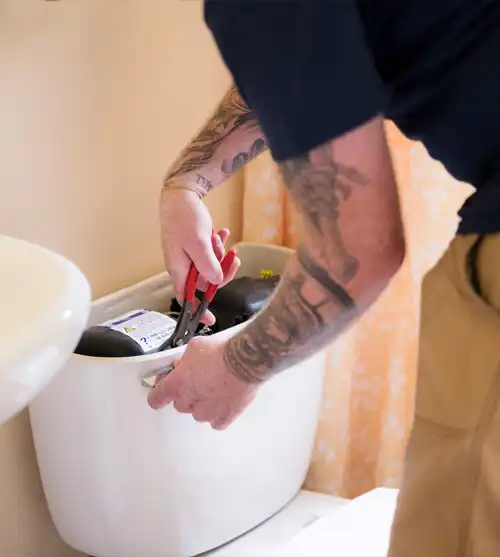
    Internal tank components wear out over time. We replace fill valves, flush valves, flappers, and handles with quality parts that hold up, and we check the supply line and shutoff valve while we are in there.

  • Toilet replacement and installation

    When a repair is not worth the cost, whether the bowl is cracked, the porcelain is stained beyond saving, or the fixture is a water-wasting relic, we remove the old unit and install a new one. We handle the shutoff, the supply line, the flange, the wax seal, and the caulk so the installation is done to code.

  • Subfloor and waste pipe damage

    A long-running leak under a toilet can rot the subfloor and damage the waste pipe connection, especially in older row homes with wood framing over cast iron drain stacks. We assess the damage honestly and repair what is needed before setting a new toilet on a solid base.

Pricing, coupons, and financing

We do not publish flat toilet repair prices, because the right scope depends on what is actually wrong. A flapper swap is a different job from a full flange rebuild on a rotted subfloor. Pricing is confirmed on-site after diagnosis and before any work starts. We do not change the price after the fact.

  • Repair or replace

    When a repair on a cracked or outdated toilet starts running into real money, we lay out the honest comparison. Sometimes a $150 repair makes perfect sense. Other times, putting that money toward a new high-efficiency toilet that uses a fraction of the water is the smarter move. We tell you which is which and let you decide.

  • Financing

    For toilet replacements and larger bathroom projects, we offer instant approval financing through GoodLeap.

What to expect when we arrive

When you call 215-342-7200, this is how a typical toilet repair or replacement call runs.

  • 1. Triage on the phone

    We ask what the toilet is doing, how long it has been happening, whether there is visible water on the floor, and whether the home has one bathroom or more than one. That tells us what to bring and how fast to get there.

  • 2. Diagnostic on arrival

    The technician inspects the toilet, the tank internals, the base connection, the shutoff valve, and the drain line rather than guessing at one part. If the problem might be downstream, we say so before wasting time on the fixture.

  • 3. The real cause, explained

    We tell you what failed and why. If the toilet needs a $30 flapper, we say that. If it needs a full replacement because the bowl is cracked and the flange is shot, we say that too, in plain terms.

  • 4. The repair or installation, done right

    We carry the common failure parts on the truck. Most repairs finish in a single visit. Replacements take a couple of hours, and we test the flush, check for leaks, and confirm the shutoff works before we leave.

  • 5. Clean cleanup and paperwork

    We do not leave a mess. The old toilet is removed, the area is wiped down, and you get an itemized invoice describing exactly what was done.

Credentials that matter for toilet repair in Philadelphia

Toilet work touches your water supply, your waste system, and potentially your gas lines if you are near a water heater. The Philadelphia Department of Licenses and Inspections requires licensed, insured plumbing work that meets code and is current on proper registrations. We have been operating under that standard since 1990.

  • BBB accredited

    Listed as accredited on the Better Business Bureau.

  • Insured for the work we do

    Liability and workers' compensation coverage on file with L&I.

  • Family-owned and operated

    In business in the Philadelphia area since 1990.

Frequently asked questions about toilet repair and replacement in Philadelphia

My toilet will not stop running. Is that an emergency?+

Not usually a safety emergency, but it is an urgency. A running toilet can waste hundreds of gallons a day, and in Philadelphia where you pay for water and sewer on the same bill, that adds up fast. Call us and we will get it diagnosed and fixed, typically same-day.

How do I know if my toilet needs a repair or a full replacement?+

It depends on the problem. A worn flapper, a bad fill valve, or a leaking supply line are straightforward repairs. A cracked bowl, a severely corroded flange, or a fixture that is decades old and uses 3.5 gallons per flush usually makes replacement the better investment. We give you the honest comparison.

Why does my toilet keep clogging?+

Occasional clogs happen, but repeated clogs usually point to something beyond the fixture itself. A partial blockage in the branch line, a deteriorating cast iron drain stack, or an obstruction deeper in the waste system are all common culprits in older Philadelphia homes. We trace it to the source.

Can you replace a toilet in an older row home where the flange is cast iron?+

Yes. Older row homes frequently have cast iron flanges and waste connections that require different hardware and technique than a PVC installation. We have been working on these systems for over 30 years and carry the adapters and fittings to handle them.

Will a new toilet save me money on my water bill?+

In most cases, yes. The EPA notes that replacing an older toilet with a WaterSense labeled model can reduce water used for flushing by 20 to 60 percent, saving a household roughly 13,000 gallons per year. On a Philadelphia Water Department bill where you pay for both supply and sewer, that savings is meaningful.

Do you handle toilet work in Bucks County and Montgomery County?+

Yes, both, with the same crews dispatched out of our Northeast Philadelphia office on Cottman Avenue. Suburban homes tend to have newer fixtures and PVC waste systems, but older construction shows up everywhere, and we handle the full range.

How long does a toilet replacement take?+

Most straightforward replacements take about two hours, including removing the old toilet, inspecting the flange and supply line, setting the new unit, and testing everything. If we find a damaged flange or rotted subfloor, we tell you the additional scope and timeline before proceeding.

Schedule toilet repair or replacement in Philadelphia

Local shop, local crews, local since 1990.

Toilet repair and replacement in Philadelphia means working with fixtures and waste systems that range from brand new to well over a century old, and getting it right starts with diagnosing the actual problem. Call 215-342-7200 and we will find what failed, explain it in plain terms, and confirm the price before any work begins. We dispatch from 900 Cottman Avenue across Philadelphia, Bucks County, and Montgomery County.

Instant Approval Financing - Apply Today!

Affordable Financing for Plumbing, Heating, & Cooling

Philadelphia’s Top-Rated Plumber & HVAC Contractor

WHAT OUR CUSTOMERS SAY

play

watch video

REQUEST SERVICE

Emergency Plumbing & HVAC Service