


How much does sewer line replacement cost in Philadelphia?
Sewer line replacement cost in Philadelphia depends on more than just the size of the job. It depends on what's under your yard, how old your home is, and how the city's own infrastructure connects to your property. Two homes on the same block can face very different bills for what looks like the same problem.
That's frustrating when you're the one staring at a quote and trying to figure out if it's fair. Philadelphia's rowhome-heavy neighborhoods, older clay and cast iron piping, and tight lot lines all push costs in directions that a national average never captures.
This guide walks through what actually drives the price of a sewer line replacement here, how trenchless methods change the math, and what separates a repair from a full replacement. You'll also get a clear sense of the warning signs that mean it's time to call, and how to avoid paying for more work than your home actually needs. Keep reading to find out how to tell a fair sewer line repair or replacement quote from an inflated one before you sign anything.
What drives sewer line replacement cost in Philadelphia
Sewer line pricing isn't one number. It's a stack of variables that shift depending on the property, the pipe material, and how deep the line runs. That's the difference between a plumbing repair and service quote that makes sense and one that feels like a guess.
Philadelphia's housing stock adds its own wrinkles. Many neighborhoods, especially Philadelphia row homes, were built before modern plumbing codes existed, and the piping installed then wasn't built with a hundred years of use in mind.
- Pipe material (clay, cast iron, Orangeburg, or PVC)
- Length of the line from the house to the street connection
- Depth of the trench and soil conditions
- Access constraints from row homes, patios, or mature trees
- Whether the damage is isolated or runs the full line
Beyond the physical factors, there's the question of scope. A partial repair on a short section costs far less than a full line replacement, but a partial fix on a line that's failing everywhere just delays a bigger bill.
- Permit fees required by the City of Philadelphia
- Restoration costs for sidewalks, driveways, or landscaping
- Emergency vs. scheduled service timing
Every one of these adds or subtracts from the final number, which is why two seemingly similar homes can land on very different quotes. A technician who actually inspects the line before pricing the job is giving you a number grounded in your specific property, not a generic range.
Why Philadelphia's older housing stock matters
Rowhomes built in the early to mid-1900s often still run on the original sewer lateral, sometimes made of clay or cast iron.
A research note published through the U.S. Geological Survey examined sewer infrastructure in Pittsburgh, a city with a housing stock and pipe age comparable to Philadelphia's, and found that sewers older than 75 years show a substantially higher likelihood of leaks and structural failure.
Clay pipe joints are especially vulnerable to root intrusion, since roots seek out any moisture escaping through a seam. Once roots get a foothold, they widen the gap every season, and what started as a slow drain becomes a full blockage.
Cast iron holds up differently. It doesn't crack from roots the way clay does, but it corrodes from the inside as sediment and waste scrape at the pipe wall over decades. Eventually it thins out enough to collapse or crack.
How lot layout and access affect the bill
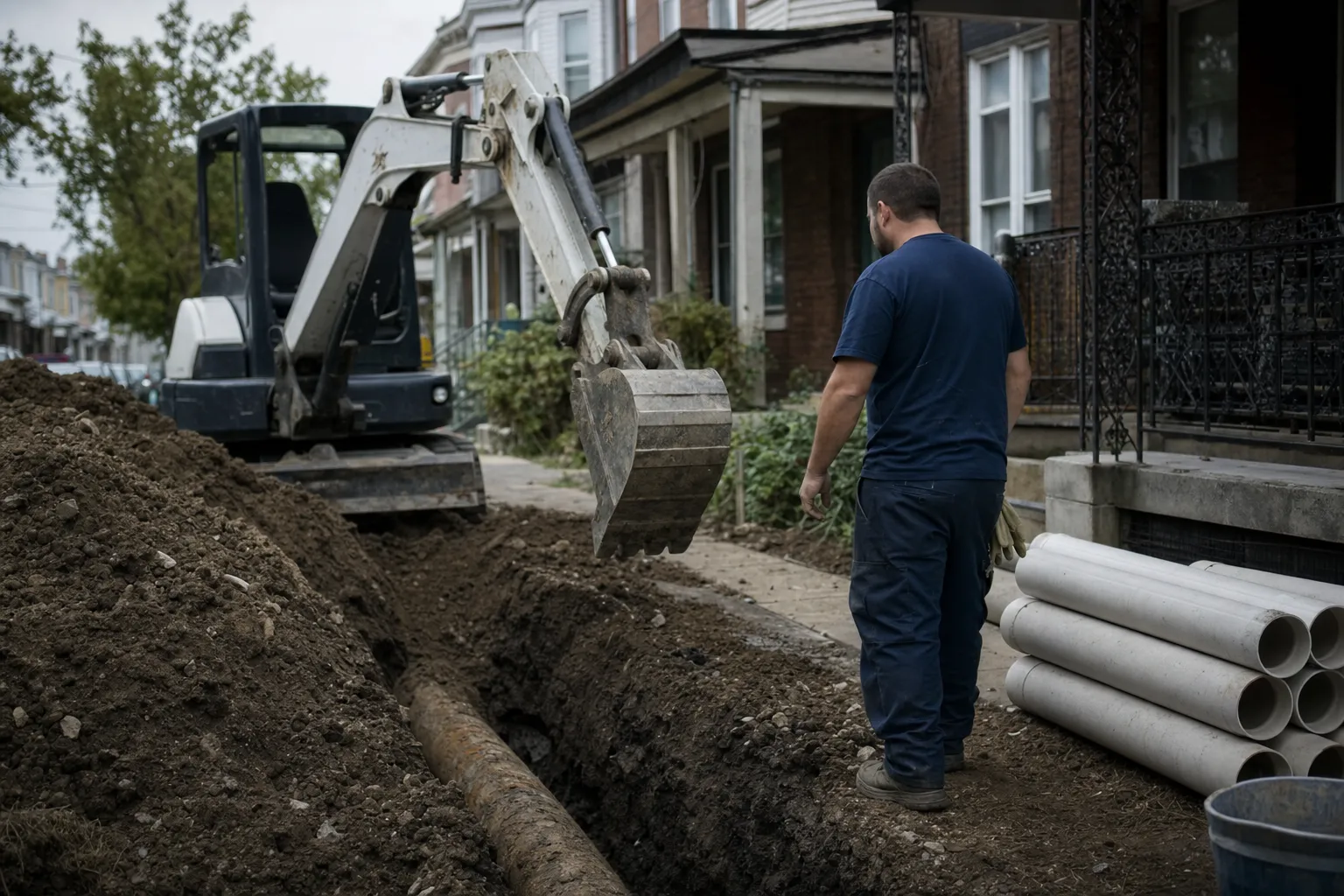
Rowhome lots are narrow, and many have limited or no side yard access. That means equipment sometimes has to come through a basement or a tight alley, which adds labor time and, in some cases, requires hand digging instead of machine excavation.
Front yards in older Philadelphia neighborhoods are often small and close to the sidewalk, which means the sewer lateral frequently runs directly under concrete, brick pavers, or a section of the public right-of-way. Restoring those surfaces after excavation is its own line item.
Homes with mature street trees face a particular version of this problem, since those same trees are usually the reason the line failed in the first place. Removing root intrusion near a valuable tree sometimes calls for a method that avoids disturbing the root system altogether.
What a fair estimate actually includes
A trustworthy estimate spells out labor, materials, permit costs, and restoration separately, rather than bundling everything into one vague number. If a quote can't explain why it costs what it costs, that's worth asking about directly.
- Camera inspection findings and where the damage sits
- Pipe material and length being replaced
- Method: trenchless, traditional excavation, or a hybrid
- Permit and restoration line items
It should also explain what happens if the crew finds something worse than expected once they start digging. Any reputable plumber will walk you through contingencies before work begins, not after the invoice arrives.
Trenchless vs. traditional sewer line replacement
The method used to replace a sewer line has a bigger impact on total cost, timeline, and property disruption than almost any other factor. Philadelphia homeowners increasingly ask about trenchless options because they promise less digging, but the choice depends heavily on the specific damage.
Traditional excavation means digging a trench along the entire length of the failed pipe. It's the most invasive option, but it's also the most direct way to deal with pipes that have collapsed, shifted, or bellied out of alignment.
- Full access to inspect and replace every section
- Best option for severely collapsed or misaligned pipe
- Requires full yard, driveway, or sidewalk restoration
- Typically the longer project timeline of the two methods
Trenchless methods, by contrast, use small access points instead of a full-length trench. Two main approaches dominate the trenchless world: pipe bursting and cured-in-place pipe (CIPP) lining.
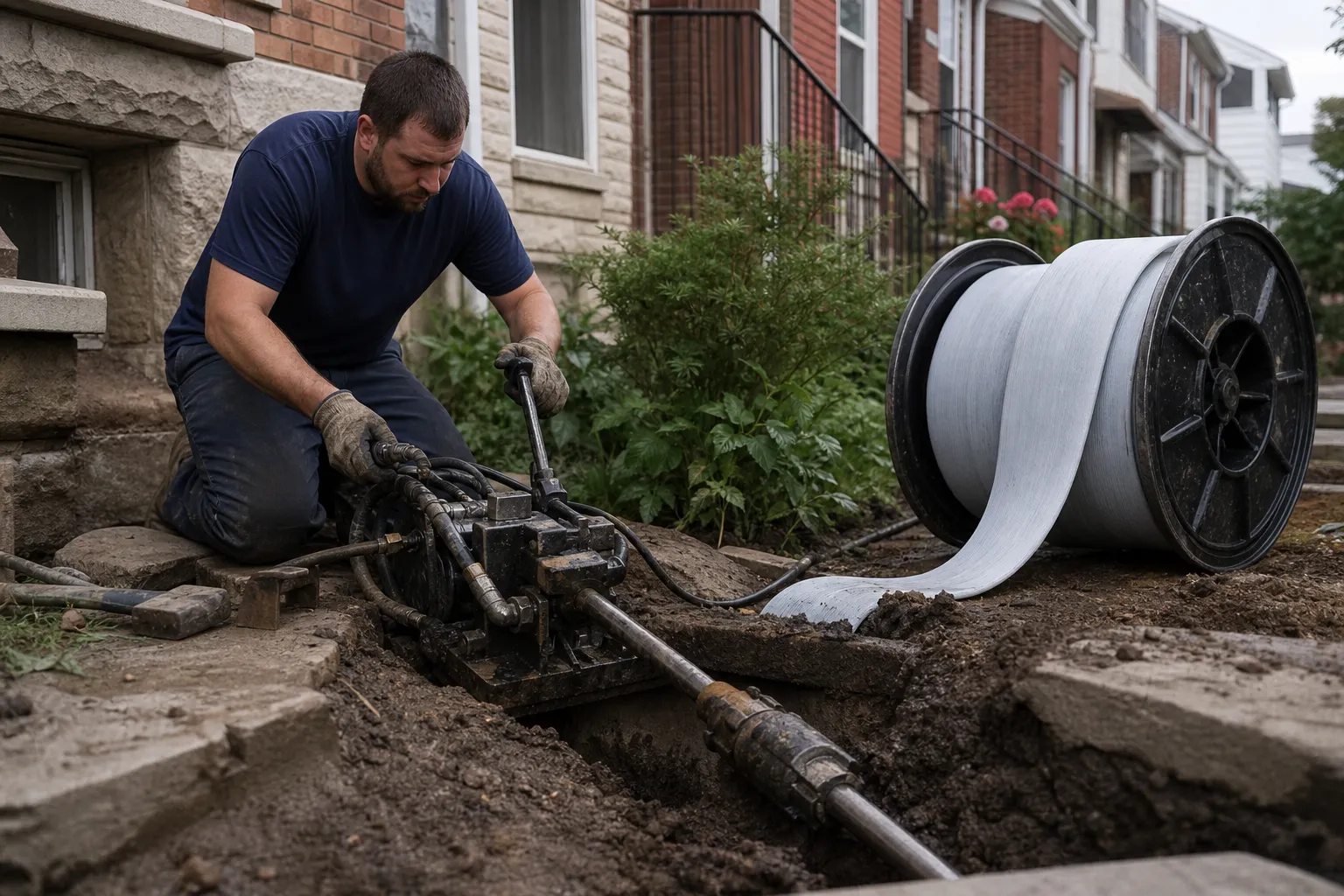
- Pipe bursting: a new pipe is pulled through the old one while a bursting head fractures the original pipe outward into the surrounding soil
- CIPP lining: a resin-saturated liner is inserted into the existing pipe and cured in place, forming a new pipe within the old one
- Both methods typically need only two access pits instead of a full trench
When trenchless makes sense
Trenchless methods work best when the existing pipe still holds its general shape, even if it's cracked, root-infiltrated, or corroded. The old pipe acts as a guide for the new one, so a pipe that has fully collapsed or shifted out of alignment isn't a good trenchless candidate.
Rowhome properties with limited yard access are frequently strong candidates for trenchless work, since the reduced digging footprint avoids disturbing shared walls, tight alleys, or a neighbor's fence line.
CIPP lining slightly reduces the interior diameter of the pipe, since the liner adds a layer inside the original pipe. For most residential lines, that reduction doesn't meaningfully affect flow.
When traditional excavation is still the right call
A pipe that has collapsed, separated at a joint, or bellied downward from ground settling can't be fixed by lining or bursting through it. In those cases, excavation is the only method that actually solves the problem.
Excavation also becomes necessary when the sewer lateral needs to be rerouted entirely, such as when a tree's root system has made the original path impractical to preserve long term.
Cost comparison between the two methods
Trenchless methods generally carry a higher per-foot material and equipment cost, but that's frequently offset by lower labor hours and dramatically lower restoration costs, since there's no full trench to backfill and repave.
Traditional excavation tends to cost less per foot in raw materials but adds labor-intensive digging, potential concrete or asphalt removal, and full landscaping or hardscaping restoration once the pipe is in.
The right comparison isn't which method is cheaper per foot. It's which method actually fixes the specific failure in front of you, since the wrong method for the damage means paying for a fix that doesn't hold.
Signs your sewer line needs repair or replacement
Sewer line problems rarely happen without warning. Most homeowners notice smaller symptoms for weeks or months before the situation becomes an emergency, and catching those signs early usually means a smaller repair bill.
The tricky part is that many symptoms look like ordinary drain problems at first. A slow drain in one sink might just be that sink, or it might be the first sign that the main line is struggling.
- Multiple drains backing up at the same time
- Gurgling sounds from toilets when other fixtures run
- Sewage odor in the yard or basement
- Unusually lush or soggy patches in the lawn
- Toilets that bubble or drain slowly across the house
When more than one fixture is affected at once, that's the strongest signal the problem sits in the main line rather than in a single branch drain. A single slow sink is usually isolated; several slow drains across the house point toward one shared bottleneck.
The difference between a repair and a full replacement
A repair addresses a localized problem: a single crack, a section with root intrusion, or a joint that has separated. A full replacement becomes necessary when the damage runs the length of the pipe, when the pipe material has reached the end of its service life, or when repeated pipe repair and repiping work hasn't solved a recurring issue.
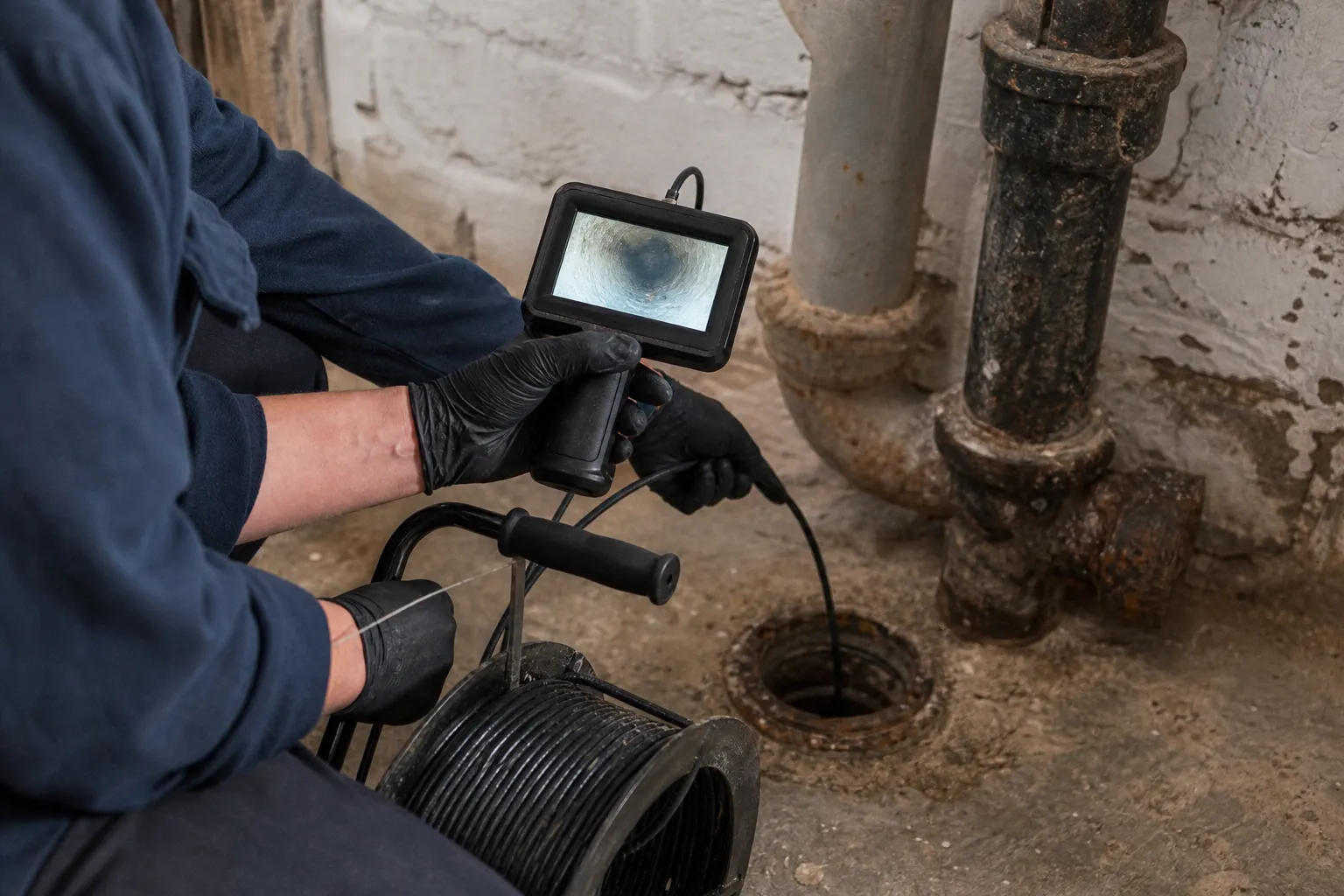
Camera inspection is the tool that actually answers this question instead of guessing. A technician runs a small camera through the line and can see exactly where damage sits, how extensive it is, and whether the surrounding pipe still looks sound.
- Camera inspection identifies the location and extent of damage
- The technician evaluates pipe material and overall condition
- A recommendation follows: spot repair, partial replacement, or full replacement
Why root intrusion is the most common cause locally
Philadelphia's mature street trees and older clay piping are a difficult combination. Clay pipe joints were never sealed as tightly as modern PVC, and tree roots are relentless about finding any source of moisture underground.
Once a root gets into a joint, it doesn't stop growing. It thickens every season, and the same crack that let in a thin root eventually widens enough to let in a much larger root mass, which is when blockages start happening regularly instead of occasionally.
Signs the problem has become urgent
A single backup that clears on its own is annoying but not necessarily urgent. Repeated backups within a short window, especially ones that happen right after heavy rain, usually mean the line has lost most of its capacity.
- Sewage backing up into the lowest drain in the house
- Standing water or sewage odor after rainfall specifically
- A camera inspection showing a full or near-full blockage
Any of those signs means it's time to schedule a proper inspection rather than waiting to see if the problem resolves on its own. If backups are happening on a repeat basis, an emergency plumber visit is the faster path to an answer than waiting out another cycle.
Planning, permits, and paying for the project
A sewer line replacement is disruptive enough without also being confusing. What to expect on permits, timeline, and payment options ahead of time makes the whole process easier to plan around.
The City of Philadelphia requires permits for sewer lateral work, since the line connects to the public sewer system and any work near the connection point has to meet code. A licensed Philadelphia plumber handling the permit process is one less thing for a homeowner to manage directly.
- Permit application and city inspection requirements
- Coordination with PWD (Philadelphia Water Department) where the lateral meets the main
- Restoration standards for sidewalks and street-adjacent areas
Financing has become a more common part of these conversations, since a sewer line replacement is rarely a planned expense. Many homeowners weren't budgeting for a project like this, and a plumber who offers financing options is solving a real logistics problem, not just upselling.
- Get a camera inspection before agreeing to any specific method
- Confirm what permits are required and who's pulling them
- Ask for a written scope that separates labor, materials, and restoration
- Discuss financing options if the project isn't already budgeted
- Confirm the timeline, including restoration, not just the excavation or lining itself
What to expect during the project itself
Traditional excavation projects typically run longer, since the trench has to be dug, the pipe replaced, and the area backfilled and restored before the crew is finished. Weather and soil conditions can extend that timeline further.
Trenchless projects usually move faster, since there's no full trench to dig or restore. Most residential trenchless jobs can be completed within a single working day once the inspection and planning are done.
Why replacing your line is about more than one house
Philadelphia's sewer lateral issues aren't unique to older rowhomes here. Nationally, aging sewer infrastructure is a documented problem, and the failures showing up in older cities follow a predictable pattern tied to pipe age and material.
A report compiled from EPA infrastructure data notes that aging pipes and inadequate capacity nationwide have contributed to an estimated 900 billion gallons of untreated sewage and wastewater entering U.S. waterways each year, a figure tied directly to how much of the country's underground sewer network was installed generations ago.
That same aging pattern explains why cast iron and clay laterals across entire blocks in Philadelphia tend to fail within a similar window of each other, since they were installed during the same building boom.
Getting the right team on the job
Not every plumbing company handles sewer line replacement the same way, and the difference shows up in both price and outcome. A drain cleaning and hydro jetting service that clears a line without addressing the underlying pipe condition only buys time, not a solution.
Ask directly whether the crew doing the digging or lining is the same crew that ran the camera inspection, since a disconnect between diagnosis and execution is where miscommunication and change orders tend to happen.
Conclusion
Sewer line replacement cost in Philadelphia comes down to a handful of concrete factors: pipe material, length, access, and the method used to fix it. None of that is guesswork once a camera inspection shows exactly what's happening underground, and it's the difference between paying for the right fix and paying twice for the wrong one.
Rowhome lots, older clay and cast iron piping, and mature street trees all make this market a little more complicated than a national average can capture. That's exactly why a proper inspection matters more here than it might somewhere with newer infrastructure and wider lots.
If you're seeing slow drains, gurgling toilets, or a lawn that's suspiciously soggy in one spot, don't wait for it to become an emergency. Guaranteed Plumbing can inspect your line, walk you through what's actually going on, and lay out a clear, honest path forward, whether that's a targeted repair or a full replacement done right.