


How plumbing code compliance protects homes and property value in Philadelphia
Most Philadelphia homeowners do not think about plumbing code until something goes wrong, and by then the conversation is usually about repairs rather than prevention. But the code is not a bureaucratic hurdle. It is a documented set of standards built from decades of failures, waterborne illness outbreaks, structural collapses, and property losses, all of which were traced back to installations that no one checked.
When work is done to code and properly permitted in Philadelphia, those standards are what stand between your home and the kinds of problems that cost tens of thousands of dollars to undo.
The city's plumbing code operates under the 2018 International Plumbing Code with local amendments, adopted through Philadelphia's Building Construction and Occupancy Code and enforced by the Department of Licenses and Inspections.
Philadelphia also falls under the Pennsylvania Uniform Construction Code, established by Act 45 of 1999, which sets the baseline standards that local amendments must meet or exceed. That layered framework means the plumbing in your home has to satisfy both state minimums and Philadelphia-specific requirements that account for local conditions.
According to the U.S. Environmental Protection Agency, the average household leaks nearly 10,000 gallons of water per year. Many of those leaks trace back to failed connections, improper materials, or installations that were never inspected. Code compliance is the mechanism that catches these problems at the point of installation, before the water has had years to work its way into your structure.
In this article, you will learn about:
- What Philadelphia's plumbing code actually requires and why it matters
- How unpermitted plumbing work creates financial and legal exposure
- The ways code-compliant plumbing protects your home's structure and health
- What code compliance means when you sell a Philadelphia property
Keep reading to understand why this matters for your home's long-term value and what to do if you suspect prior work was not done to code.
What Philadelphia's plumbing code actually requires
Philadelphia's plumbing code covers every system that moves water or waste through a residential or commercial building. That includes supply lines, drain lines, venting, fixture connections, water pressure, pipe materials, and how those systems interact with the building structure. The requirements are not arbitrary. Each one addresses a specific failure mode that has caused documented harm.
The code requires that all plumbing work be performed by a licensed plumber and that most significant work be permitted through the Department of Licenses and Inspections before it begins. Permitted work gets inspected before walls close or connections are made permanent. That inspection is the moment where a problem discovered in the installation costs an hour to fix instead of a full wall demolition.
The permit requirement and what it actually triggers
Pulling a permit for plumbing work in Philadelphia triggers a formal review and inspection process. The permit documents what work was done, by whom, and that it passed inspection. That documentation follows the property. When a home is sold, the permit history is part of what buyers and their inspectors look for to confirm that prior work was done legally and to a standard.
Work done without a permit leaves no such record. It may have been done correctly, or it may not have been. Without an inspection, there is no way to know from the outside. A buyer's inspector who finds evidence of unpermitted plumbing work, exposed connections that do not match the age of the surrounding pipe, fixtures installed outside code-compliant locations, or drain configurations that do not follow standard venting practices, will flag it. That flag opens a negotiation at best and a deal-ending condition at worst.
The Department of Licenses and Inspections in Philadelphia enforces code requirements and can issue stop-work orders, civil penalties, and corrective orders for violations. Homeowners who discover unpermitted work after the fact can sometimes pull a retroactive permit and pass a post-installation inspection, but this requires a licensed plumber to evaluate and certify the work, and any sections that do not meet code have to be corrected regardless of when they were installed.
How the L&I inspection process actually works
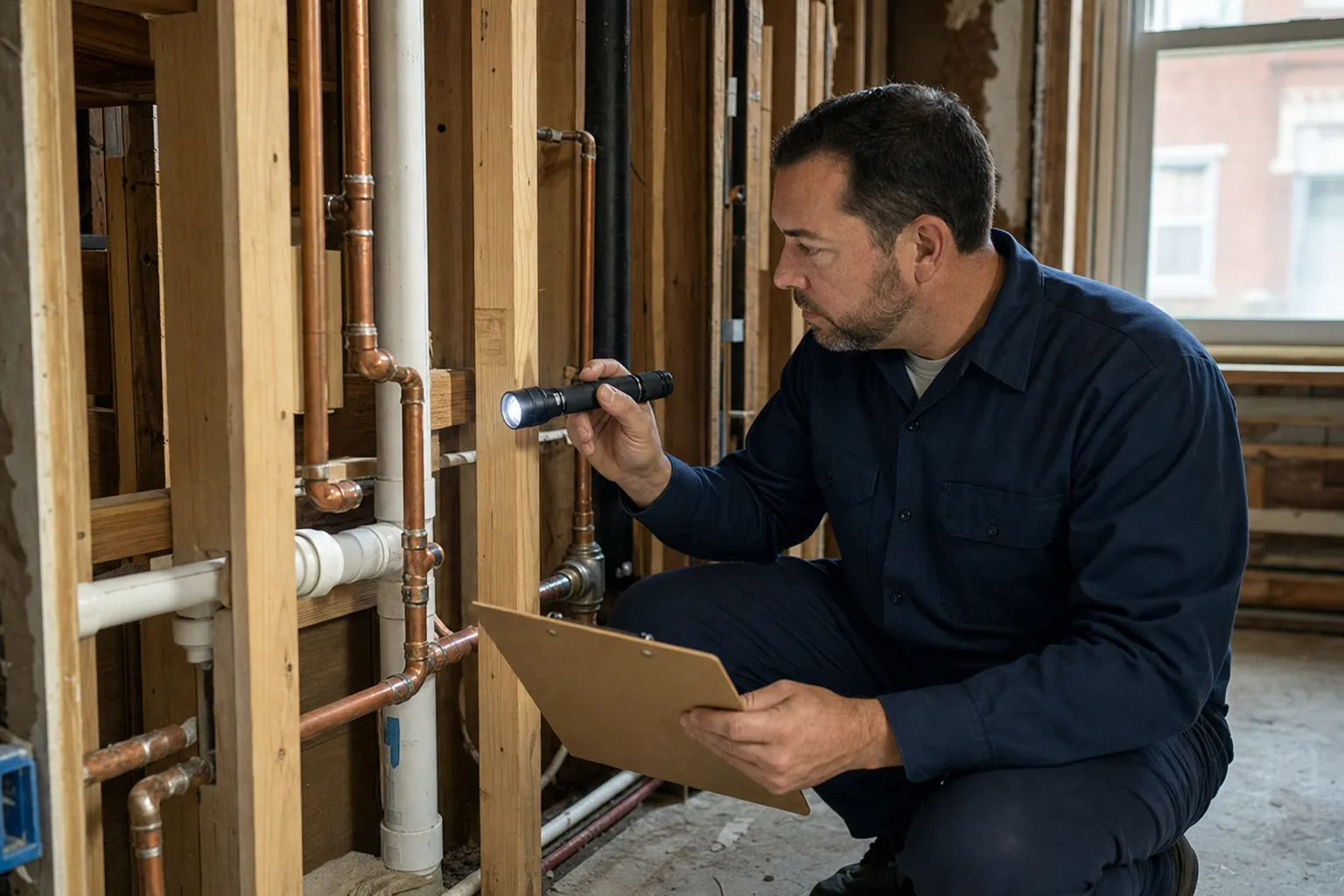
After a permit is issued, the work moves through a defined inspection sequence before it can be closed out. Rough plumbing, meaning supply and drain lines before walls are covered, requires an inspection before concealment. Finished plumbing, meaning fixtures and final connections, requires a second inspection. Both inspections are scheduled through the Department of Licenses and Inspections and conducted by a city inspector who verifies that the installation matches the permitted scope and meets code requirements.
Homeowners sometimes ask whether the inspection process slows down a project. In practice, the schedule impact is minimal for work planned in advance. The risk of skipping it, an unknown installation condition that causes damage years later with no inspection record to reference, far outweighs the scheduling consideration. Toilet repairs and drain work done correctly the first time, with permits and inspections, do not become problems five years later during a sale.
Key technical requirements that protect structure and safety
Several specific code requirements exist precisely because they address real structural and health risks in Philadelphia's housing stock.
Venting requirements are one of the most commonly misunderstood. Every drain in a properly coded plumbing system connects to a vent stack that allows air into the drain line and prevents siphoning.
When a trap loses its water seal through siphoning, sewer gases including hydrogen sulfide and methane can enter the living space. The Philadelphia code specifies vent sizing, placement, and how branch vents connect to the main stack based on the fixture type and distance. A bathroom added to a basement in a Northeast Philadelphia rowhouse without proper venting is not just a code violation. It is an ongoing health exposure.
Water pressure requirements protect both the supply system and the fixtures connected to it. Excessive water pressure accelerates wear on supply line connections, valve seats, and appliance inlets. The code sets maximum pressure limits and requires pressure-reducing valves in systems that exceed them.
A supply connection installed without attention to pressure in an older Philadelphia home, where street pressure can vary significantly by neighborhood, can fail at a connection point and produce the kind of water event that causes pipe repair and repiping work that far exceeds the cost of getting the original installation right.
Pipe material requirements specify which materials are acceptable for which applications and how they have to be joined. Using improper materials, mixing incompatible metals without dielectric fittings, or using residential-grade pipe in a location that requires something more durable creates a system that may function for years before failing. When it does fail inside a wall or under a slab, the repair cost includes not just the pipe but everything around it.
How unpermitted work creates financial and legal exposure
The most immediate financial risk from unpermitted plumbing work is what it does to a transaction. Philadelphia home sales routinely involve inspection contingencies, and a buyer's inspector finding evidence of work without permits gives the buyer leverage to request price reductions, require repairs before closing, or walk away. In a market where buyers have options, unpermitted work is a genuine deal obstacle.
Beyond transactions, unpermitted work affects insurance claims. A homeowners policy covers sudden and accidental damage from plumbing failures, but coverage can be complicated by unpermitted work that contributed to the failure. An insurer investigating a significant water damage claim may deny or reduce coverage if they find that the affected system was installed without permits in a way that does not meet code.
What happens when unpermitted work is discovered during renovation
Renovation projects frequently surface unpermitted prior work. A contractor opening a wall to replace a drain stack finds a previous repair done with incompatible materials and no inspection. A bathroom renovation reveals a drain configuration that does not match code. At that point, the homeowner is responsible for bringing the work into compliance before the new project can be permitted.
This is one of the most common sources of renovation cost overruns in Philadelphia's older housing stock. A bathroom renovation budgeted at a certain amount becomes significantly more expensive when it uncovers a generation of unpermitted plumbing problems that has to be addressed before the new permit can be closed. Layered work across multiple decades of ownership makes this scenario common across the city's rowhouse stock.
When unpermitted work shows up in an L&I violation search
Philadelphia maintains a public database of L&I violations, permits, and complaints tied to individual properties. Buyers and their agents routinely search this database before and during a transaction. A property with open violations or a history of complaints about unlicensed work is visible to anyone who looks, and it creates questions that slow or derail a sale.
An open violation requires resolution before a property can transfer with clear title in many circumstances. A violation from unpermitted plumbing work discovered years after the fact still has to be addressed and the work either brought up to code or demolished and redone. For sellers, this is the scenario most worth avoiding with a proactive approach before listing. For buyers, the L&I search is a standard due diligence step that a good buyer's agent will always run. The same code violations that derail Montgomery County transactions recur just as often in Philadelphia's older rowhouse stock.
The liability exposure for sellers
Pennsylvania's seller disclosure law requires disclosure of known material defects. A seller who knows about unpermitted plumbing work and does not disclose it faces potential liability after the sale if that work causes damage or fails inspection. Sellers who address unpermitted work before listing by having a licensed plumber evaluate and permit the existing installation where possible, or correct and permit it where not, remove that liability and eliminate the negotiating leverage it would otherwise hand to a buyer.
The calls to an emergency plumber that follow the discovery of a failed unpermitted repair often happen during a transaction or immediately after one, when the new owner is learning what they actually bought. That scenario is avoidable on both sides of the sale.
Code compliance as structural and health protection
The financial arguments for code compliance are real, but the underlying purpose of the code is structural and public health protection. The requirements exist because Philadelphia's housing stock, much of it built before modern standards, has produced documented cases of waterborne contamination, structural failures from chronic leaks, and health problems from sewer gas exposure, all of which were connected to installations that were never inspected.
Drain and waste venting is the clearest health example. The trap seals at each fixture rely on a properly functioning vent system to stay intact. A poorly vented system does not always announce itself loudly.
A P-trap that has been siphoned dry over time allows sewer gas into the house at a low, chronic level. Hydrogen sulfide at low concentrations causes headaches and nausea before it reaches concentrations detectable by smell. Households dealing with unexplained odors or health symptoms that correlate with bathroom use sometimes trace the issue to a venting problem in work that was never inspected.
Water quality protections built into the code
Philadelphia's plumbing code addresses cross-connection control, which prevents non-potable water from contaminating the supply. A cross-connection occurs when a supply line can be backsiphoned into the potable water system from a contaminated source, a garden hose left submerged in a pesticide bucket, a boiler fill line without a backflow preventer, or a toilet supply that lacks the required air gap.
The U.S. Centers for Disease Control and Prevention identifies cross-connection contamination as one of the leading causes of waterborne illness outbreaks connected to building plumbing systems. The backflow prevention requirements in Philadelphia's code exist precisely to prevent this. A plumber who installs a system without the required backflow preventers is leaving the home's occupants exposed to a contamination risk that can be invisible until it produces a health event.
How frozen pipe protection requirements reduce winter damage risk
Philadelphia's plumbing code, under Section P-305.4, explicitly prohibits installing water, soil, and waste pipes in locations subject to freezing, including outside walls, uninsulated attics, and exposed crawl spaces, unless adequate freeze protection is provided. This is a structural protection requirement as much as a safety one.
In Philadelphia's climate, where temperatures drop below freezing reliably from December through February, pipes installed outside code-specified locations are at real risk of freeze events.
According to FEMA, just one inch of water inside a home can cause up to $25,000 in damage. A burst pipe in an exterior wall cavity produces that kind of water volume quickly. The code requirement exists because decades of winter damage claims established exactly where pipes fail. Compliant installations built to those standards are not invulnerable, but they are not installed in the locations where freeze failures happen most.
Structural protection through proper pipe support and material standards
Code requirements for pipe support spacing, penetration protection, and material compatibility exist because improperly supported or protected pipe causes structural damage over time. A drain stack that lacks the required support intervals eventually deflects at the joints, creating leak points inside walls. A pipe that penetrates a fire-rated assembly without the required fire-stop protection does not just violate code. It creates a pathway for fire to travel through the building.
In Philadelphia's rowhouses, where units share party walls and fire travel between units is a real risk, penetration protection requirements are not abstractions. The boiler repair and installation work done in attached rowhouses follows similar logic. Work that affects a shared structure requires the code compliance and inspection process precisely because the risks are not contained to one unit.
What code compliance means when you sell a Philadelphia property
The resale implications of plumbing code compliance are concrete. Buyers in Philadelphia's market are increasingly represented by experienced inspectors who know what to look for in the city's older housing stock. A home where all plumbing work has documented permit histories, where no flags appear in the L&I violation database, and where the systems function correctly without visible improvisation, sells differently than one with a history of unpermitted work or outstanding violations.
The sewer line repair and replacement work that comes up during pre-sale inspections is often the most significant single item in a negotiation. Sellers who have maintained their lateral and have permitted documentation for any prior repairs are in a stronger position than those who discover a decades-old condition during the transaction.
According to the Insurance Information Institute, water damage and freezing accounted for 27.6% of all homeowners insurance claims in 2022. A significant share of those claims involve systems that were modified without permits or maintained below code standards. A home with a documented compliance history presents a different risk profile to both buyers and insurers.
What buyers and their inspectors actually look for
A buyer's home inspector in Philadelphia is not conducting a code enforcement inspection. They are assessing the condition and apparent compliance of visible systems. But experienced inspectors in this market know what unpermitted work looks like in Philadelphia's housing stock, and they know where to look for it.
The signs they check for include:
- Drain configurations that do not follow standard venting patterns for the fixture type and location.
- Pipe materials that do not match the age or permit history of the surrounding system.
- Fixture locations in basements or additions that lack proper cleanout access.
- Supply connections under sinks or behind fixtures that use non-approved fittings or informal repairs.
- A water heater installation that lacks the required pressure-relief valve discharge pipe termination.
Any of these findings becomes a line item in the inspection report. The water heater inspection findings that appear in reports on Abington, Mayfair, and Northeast Philadelphia properties often trace to installations done during prior renovations without permits. They are fixable, but they cost the seller negotiating position if discovered during the buyer's inspection rather than addressed beforehand.
The pre-sale plumbing evaluation
Having a licensed plumber walk through the home before listing is a practical step that identifies outstanding issues on the seller's timeline rather than the buyer's. That evaluation can surface unpermitted work, aging connections that are likely to fail under inspection scrutiny, sewer lateral conditions that a buyer's inspector will flag, and fixture or fixture-connection problems that are inexpensive to correct before they become negotiating points.
The goal is not to achieve perfection before listing. It is to eliminate surprises. A seller who walks into a transaction knowing exactly what the plumbing looks like is in a better position than one learning about it for the first time during the inspection period. Homeowners in Elkins Park, Glenside, and surrounding communities selling properties with similar older housing stock benefit from the same pre-sale evaluation process.
Maintaining compliance after permitted work is done
Code compliance is not a single event at the time of installation. It is an ongoing condition of the system. Fixtures have to remain in working order, drain traps maintained with water seals, and any modifications made with permits and inspections. A home that was fully code-compliant at the time of its last renovation but has had unlicensed work added since is no longer fully compliant.
The practical takeaway is straightforward: any time plumbing work is done in a Philadelphia home, a permit should be pulled if the scope requires one, and the work should be done by a licensed plumber who knows the Philadelphia code requirements. The cost of doing it right the first time is always lower than the cost of correcting it under time pressure during a sale or after a claim.
Conclusion
Plumbing code compliance in Philadelphia is not a formality. It is the practical record that the work in your home was done correctly, by someone qualified to do it, and that an inspector confirmed it before the walls closed. That record has real value at the time of a sale, a claim, and anytime a future renovation opens up a system that a prior owner touched.
The code requirements for venting, backflow prevention, pipe materials, and pressure management are not arbitrary. Each one addresses a documented failure mode. Following them protects the structure, the health of the occupants, and the financial value of the property over time.
If you have questions about your home's plumbing compliance, need permitted work done, or want a pre-sale evaluation by a plumber who knows Philadelphia's code requirements, Guaranteed Plumbing & Heating has served the city and surrounding area since 1990. Call 215-342-7200 to schedule a visit.