




How to lower cooling costs during summer in Bucks County without losing comfort
Your air conditioner is the single biggest line item on your summer electric bill, and in Bucks County, it starts working in late May and does not let up until mid-September. If you want to lower cooling costs during summer in Bucks County, you do not have to sit in a warm house and suffer. You have to stop paying for air conditioning that never reaches the rooms it is supposed to cool.
Most of the money homeowners waste on cooling is invisible. It leaks out through ductwork in the attic. It escapes around window frames and door seals. It gets absorbed by a system running on a clogged filter or a refrigerant charge that drifted low two summers ago.
The U.S. Energy Information Administration reports that space heating and air conditioning account for more than half of the average household's annual energy consumption. In a humid climate like Bucks County's, cooling is the dominant half of that equation from June through August.
The good news is that the highest-impact fixes are not expensive, and most of them do not require replacing your system. They require finding where the money is going and closing the gap. This article covers the specific changes that produce real savings, in the order that matters most.
In this article, you will learn about:
- Your ductwork is probably leaking more money than your faucets ever will
- 78 degrees sounds warm until you pair it with the right tricks
- That dirty filter is costing you more than you think
- Ceiling fans do not cool rooms, but they fool your body in the best way
- The air leaks you walk past every day without noticing
- Your kitchen is secretly heating your house all summer
- When the system itself is the problem, not how you use it
Keep reading to learn which changes pay for themselves fastest and which ones keep compounding savings every summer after that.
Your ductwork is probably leaking more money than your faucets ever will
If you could only fix one thing to lower your cooling costs, this would be it. Duct leaks are the single largest source of wasted energy in most Bucks County homes, and they are almost entirely invisible.
Where your cooled air actually goes
According to ENERGY STAR, 20 to 30 percent of the air moving through a typical home's duct system is lost to leaks, holes, and poorly connected joints. That means for every dollar you spend cooling your home, 20 to 30 cents worth of cooled air ends up in your attic, your crawl space, or your walls, places where nobody lives and nobody benefits.
In Bucks County homes built before the 1990s, the ductwork was often installed with minimal sealing. Sheet metal joints were taped with cloth-backed duct tape, which dries out and fails within a few years. Flex duct connections were clamped loosely. Return air plenums were built from wall cavities that were never designed to be airtight. The result is a system that has been quietly bleeding conditioned air for decades.
What it feels like from inside the house
If certain rooms never cool down no matter what you set the thermostat to, or if the upstairs is always five to eight degrees warmer than the main floor, leaky ducts are likely contributing. The system is producing enough cool air at the air handler, but a significant portion of it never makes it to the registers. You compensate by turning the thermostat down further, which makes the system run longer, which costs more, which still does not fix the rooms that are not getting airflow.
What sealing actually involves
A technician seals duct joints with mastic sealant or metal-backed foil tape rated for HVAC use, not standard duct tape, which is not suitable for ductwork despite the name. ENERGY STAR notes that leaky ducts can reduce heating and cooling system efficiency by as much as 20 percent, and that sealing and insulating ducts increases efficiency, lowers energy bills, and can often pay for itself in energy savings. For ducts in unconditioned spaces like attics and crawl spaces, adding insulation around the sealed ducts prevents further heat gain in summer and heat loss in winter.
78 degrees sounds warm until you pair it with the right tricks
Most homeowners set the thermostat somewhere between 70 and 74 and leave it there all summer. That feels comfortable, but it comes at a price that adds up fast.
What the numbers say about every single degree
The U.S. Department of Energy recommends setting your thermostat to 78 degrees when you are home and awake for the best balance of comfort and efficiency. Each degree you set below 78 adds roughly 3 to 4 percent to your cooling costs. Dropping the thermostat from 78 to 72, a common setting in many homes, increases your cooling bill by approximately 18 to 24 percent over the course of the summer.
That does not mean you have to live at 78 and feel warm. It means 78 is the baseline, and you use other strategies covered in this article, fans, shade, air sealing, humidity control, to make 78 feel cooler than it sounds. The homeowners who save the most are not the ones who tolerate discomfort. They are the ones who close the gaps that make lower thermostat settings necessary.
When you are not home, the thermostat should know it
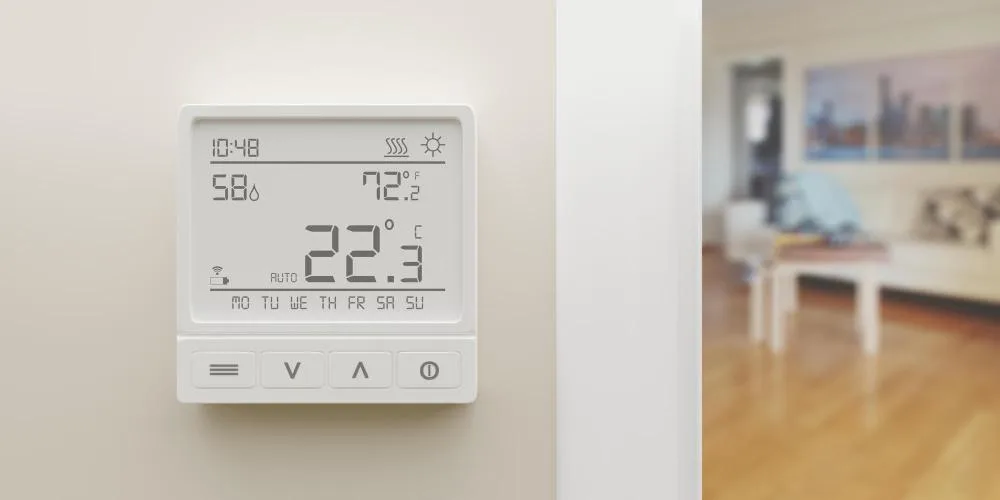
A programmable or smart thermostat pays for itself quickly by raising the temperature automatically when nobody is in the house. There is no reason to cool an empty home to 74 degrees while everyone is at work. Setting the system to 85 or turning it off entirely during the day, and scheduling it to cool back down 30 minutes before you arrive, eliminates hours of unnecessary runtime every weekday.
Smart thermostats take this further by learning your schedule, adjusting for occupancy, and optimizing run cycles based on how quickly your home gains heat. The DOE estimates that a programmable thermostat can save homeowners roughly 10 percent on annual heating and cooling costs.
The overnight setting most people get wrong
Cooling your home to 72 at night feels great, but your body naturally tolerates slightly warmer temperatures during sleep. Raising the overnight setting by just two or three degrees, especially with a ceiling fan running, reduces the system's runtime during the longest continuous stretch it operates. Over a full summer, the nighttime setting is one of the highest-leverage adjustments you can make.
That dirty filter is costing you more than you think
Changing the air filter is the most repeated piece of HVAC advice in existence, and it is also the most ignored. There is a reason every technician mentions it: the financial impact is real and immediate.
What a clogged filter does to your system
When the filter is dirty, airflow through the evaporator coil drops. Less air moving across the coil means less cooling per cycle, which means longer run times to reach the set temperature. The system works harder, draws more electricity, and delivers less comfort. According to the Northeast Energy Efficiency Partnerships, clearing a clogged AC filter alone can save 5 to 15 percent in energy use.
Beyond efficiency, restricted airflow can cause the evaporator coil to drop below freezing and ice over. A frozen coil stops cooling entirely and can damage the compressor if the system continues to run. What started as a three-dollar filter change becomes a service call, and potentially a much more expensive repair.
How often you actually need to change it
The standard recommendation is every one to three months during the cooling season. If you have pets, if construction or renovation is happening nearby, or if the home sits near a busy road, the filter loads faster. Pull it out and look at it. If you cannot see light through it, it is time. In Bucks County's humid summers, the filter also traps more moisture-laden particulate, which accelerates loading compared to drier climates.
The filter your system actually needs
Not every filter is right for every system. High-MERV filters trap finer particles, which is better for air quality, but they also restrict more airflow. If your system was not designed for a high-MERV filter, installing one can create the same airflow restriction as a dirty standard filter. Check your system's specifications or ask your technician what MERV rating your equipment can handle without starving for air.
Ceiling fans do not cool rooms, but they fool your body in the best way
A ceiling fan does not lower the temperature of a room by a single degree. What it does is move air across your skin, which accelerates evaporation and creates a wind chill effect that makes you feel noticeably cooler. That distinction matters, because it means the fan only works when someone is in the room.
The 4-degree thermostat raise
The U.S. Department of Energy says that using a ceiling fan allows you to raise the thermostat setting by 4 degrees without reducing comfort. A ceiling fan running on medium uses roughly 30 to 50 watts. A central air conditioner uses 3,000 to 5,000 watts per hour when running. The math is not close. If a ceiling fan lets you keep the thermostat at 78 instead of 74, the fan is paying for its annual electricity cost in a single afternoon.
The mistake that wastes every bit of that savings
Leaving ceiling fans running in empty rooms does not pre-cool the space. It adds a small amount of heat from the motor and wastes electricity for no benefit. The fan needs skin to cool. Turn it on when you walk in, turn it off when you leave. This sounds obvious, but energy audits consistently find fans running all day in unoccupied rooms, erasing the savings they were supposed to create.
Get the direction right
In summer, ceiling fans should spin counterclockwise when viewed from below. This pushes air downward and creates the direct breeze you feel on your skin. In winter, reversing to clockwise on low speed pushes warm air along the ceiling back down into the room without creating a draft. A fan spinning the wrong direction in summer still moves air, but the effect is noticeably weaker.
The air leaks you walk past every day without noticing
Your home's building envelope, the barrier between conditioned indoor air and unconditioned outdoor air, is full of small gaps that collectively add up to a significant cooling penalty.
Where the biggest leaks hide
Air leaks are not just around windows and doors, though those matter. The biggest culprits in most Bucks County homes include:
- Gaps around electrical outlets and switch plates on exterior walls, which connect directly to the wall cavity and the outside air.
- Recessed lighting fixtures in ceilings below an attic, which are often unsealed and act as open holes into the hottest space in the house.
- Plumbing and wiring penetrations where pipes and cables pass through floors, walls, and the top plates of exterior walls into the attic.
- The attic hatch or pull-down stair, which in most homes has no weatherstripping and no insulation on the door itself.
- Dryer vents, exhaust fan ducts, and range hood vents that do not have functioning dampers.
The Edison Electric Institute notes that air leaking through cracks and openings can account for up to 30 percent of a cooling system's energy consumption. Sealing these gaps with caulk, spray foam, and weatherstripping is one of the lowest-cost, highest-return improvements a homeowner can make.
You can find many of them yourself
On a windy day, hold a lit incense stick near outlets, windows, doors, and any visible penetration on an exterior wall. Where the smoke wavers or gets pulled, air is moving through. A more thorough approach is a professional energy audit, which uses a blower door test and thermal imaging to map every leak in the envelope. Either way, every gap you seal is air you do not have to cool twice.
Your kitchen is secretly heating your house all summer
Cooking is one of the most overlooked contributors to summer cooling costs, and it hits hardest during the hours when your AC is already working its hardest.
What the oven actually does to your electric bill
Running a conventional oven at 350 to 400 degrees for an hour releases enough heat to noticeably raise the temperature in the kitchen and adjacent rooms. Your air conditioner then has to remove that heat on top of the heat already entering the house from outside. The same applies to the stovetop, though to a lesser degree. When you cook dinner at 6 p.m. on a 90-degree day, the AC runs longer and harder to compensate, and peak electricity rates in many Bucks County utility plans make that extra runtime more expensive per kilowatt-hour than off-peak usage.
Grilling outside, using a microwave, using a slow cooker, or shifting oven-heavy cooking to early morning or late evening reduces the internal heat load during the hours when it costs the most to remove. This is not about giving up home cooking. It is about timing it so the AC does not have to fight it.
Lighting adds up too
The U.S. Department of Energy reports that LED bulbs use up to 75 percent less energy and produce approximately 90 percent less heat than traditional incandescent bulbs. If your home still has incandescent or halogen bulbs, especially in rooms with multiple fixtures, each one is a small heater. A bathroom vanity with six incandescent globe bulbs puts out measurable heat. Switching to LEDs reduces both the electricity the bulbs consume and the electricity the AC uses to remove the heat they produce. The savings compound.
When the system itself is the problem, not how you use it
All of the strategies above assume the air conditioning system is functioning properly. If it is not, no amount of thermostat adjustment or duct sealing will close the gap.
The signs your system is dragging down your bill
Certain performance patterns point to a system that is wasting energy on a mechanical level:
- The system runs almost continuously on hot days but still cannot reach the set temperature. This can indicate low refrigerant, a failing compressor, or a system that is undersized for the home's cooling load.
- Cooling costs have risen steadily over the past two or three summers without a change in rates or habits. Gradual efficiency loss from aging equipment, dirty coils, or degraded refrigerant charge shows up as a trend line, not a single spike.
- The system short-cycles, turning on and off every few minutes without completing a full cooling cycle. Short cycling wastes the startup energy surge and never runs long enough to dehumidify properly.
- Indoor humidity stays high even when the temperature reaches the set point, which means the system is not removing moisture effectively and you are compensating by setting the thermostat lower than you would need to otherwise.
What a tune-up actually fixes
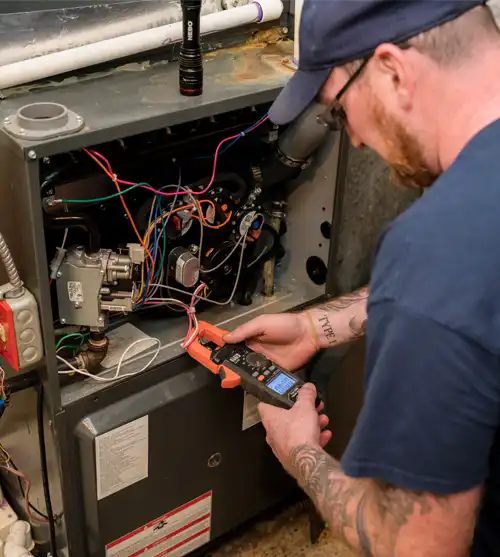
An annual AC maintenance visit is not just a filter change and a visual inspection. A thorough tune-up includes cleaning the evaporator and condenser coils, checking the refrigerant charge, testing the capacitor and electrical connections, verifying thermostat calibration, clearing the condensate drain, and confirming airflow across the coil. Each of those items directly affects efficiency. A system with dirty coils and a low refrigerant charge can use 20 percent more electricity than the same system running clean and fully charged.
ENERGY STAR warns that improper installation or poor maintenance can reduce system efficiency by up to 30 percent. A well-maintained system runs fewer hours, uses less electricity per hour, and lasts longer before needing replacement. The cost of a single annual tune-up is a fraction of the energy it saves over the season.
When the system has run its course
If your air conditioner is more than 10 to 12 years old, the repairs are getting more frequent, and the bills keep climbing despite good maintenance, the system may be past the point where tune-ups can recover its efficiency. ENERGY STAR recommends considering replacement for any heat pump or air conditioner that is more than 10 years old, especially if energy bills are rising or repairs are frequent. A properly sized modern system, installed correctly on sealed ductwork, can reduce cooling costs by 20 percent or more compared to the aging unit it replaces. That is not a number from a sales pitch. It is the difference between 2010 technology running at 80 percent of its original capacity and 2026 technology running at 100 percent.
If you are not sure where your system stands, a diagnostic visit from a technician who works in Bucks County homes every day will tell you whether maintenance, repair, or replacement gives you the best return.
Conclusion
Lowering your cooling costs in Bucks County does not require a single dramatic change. It requires closing a handful of gaps that have been quietly compounding for years. Seal the ducts. Seal the envelope. Change the filter. Use fans to earn a higher thermostat setting. Stop heating the house from the inside while the AC tries to cool it from the outside. And make sure the system itself is running the way it was designed to.
The homeowners who pay the least to stay comfortable are not the ones with the newest equipment. They are the ones who made sure every dollar of cooled air actually reaches the rooms they live in. Most of the fixes in this article cost less than a single month's summer electric bill, and they pay dividends every summer after that.
If your cooling costs have been climbing and you are not sure where the money is going, a professional assessment can pinpoint the exact losses and tell you which fixes will have the biggest impact for your home.
Guaranteed Plumbing & Heating has been serving the Philadelphia area, including Bucks County, since 1990. Call 215-342-7200 and a real person will pick up. The estimate is free, and you will know exactly what your home needs to stay cool and cost less this summer.