



What to expect during an AC replacement in Bucks County homes
What to expect during an AC replacement in Bucks County is something most homeowners only think about when the old system has already failed. By then, the timeline is compressed, the decision-making is rushed, and the details of how the installation actually works get lost in the urgency of getting the house cool again. Knowing what the process involves before that point makes the entire experience more manageable.
An AC replacement is not a single-afternoon job. It involves sizing the new system correctly, selecting equipment, scheduling the installation, removing the old unit, connecting new components, and verifying that everything performs properly before the technician leaves. Each of those steps has implications for the result, and homeowners who understand the sequence are in a much better position to ask the right questions and make informed decisions.
In Bucks County, where a mix of older colonials, newer developments, and townhomes creates a wide range of duct configurations and cooling loads, the details of how a replacement is handled matter more than the brand name on the equipment. A correctly sized, properly installed system will outperform a premium unit that was rushed in without proper preparation.
In this article, you will learn about:
- How contractors size and select the right system for your home
- What the installation day actually looks like step by step
- What affects how long the job takes
- How to evaluate the finished installation and what happens after
Keep reading to understand the full AC replacement process so you can approach it with confidence rather than uncertainty.
How contractors size and select the right system for your home
The most consequential decisions in an AC replacement happen before any equipment is ordered. Sizing and selection determine whether the new system is comfortable, efficient, and durable, or whether it short-cycles, struggles with humidity, and wears out before its time. This phase deserves more attention than most homeowners give it.
A contractor who quotes a replacement in five minutes without visiting the home or measuring anything is not doing the job correctly. Proper sizing in a Bucks County home, where insulation levels, window area, ceiling height, and duct condition vary considerably between a 1960s ranch in Levittown and a newer colonial in Doylestown, requires a real load calculation, not a rule of thumb based on square footage.
The Manual J load calculation and why it matters
The industry-standard method for sizing an AC system is the ACCA Manual J load calculation. It accounts for the home's insulation values, window area and orientation, ceiling height, local climate data, number of occupants, internal heat sources, and duct system losses. The result is a cooling load in BTUs per hour, which determines what size equipment the home actually needs.
An oversized system cools the house quickly but shuts off before it has run long enough to pull humidity out of the air. In a Bucks County summer, where humidity is a significant part of discomfort, that short-cycling leaves the house feeling clammy even when the temperature reads correctly. An undersized system runs continuously, never reaches the set temperature on the hottest days, and wears out faster under the sustained load.
Getting the size right is the single most important factor in how the new system performs over its lifetime. Homeowners should ask every contractor whether they perform a Manual J before quoting, and any contractor who does not should be pressed to explain what sizing method they use instead.
Efficiency ratings and what SEER2 means for Bucks County homeowners
Current AC equipment is rated under the SEER2 efficiency standard, which replaced the older SEER testing protocol in 2023. The U.S. Department of Energy reports that heating and cooling represent approximately 43 percent of a typical home's energy use, which means efficiency rating has a direct and meaningful effect on monthly utility costs over the system's full service life.
The DOE sets minimum efficiency standards by region, and the northeast, including Bucks County, requires a minimum of 14 SEER2 for new central AC installations. Higher-efficiency equipment, typically in the 16 to 20 SEER2 range, costs more upfront but delivers lower operating costs each month. ENERGY STAR certified central air conditioners meet efficiency thresholds that can reduce cooling energy consumption by up to 20 percent compared to standard equipment. For a Bucks County home running air conditioning from May through September, that margin shows up in every bill.
Efficiency is not the only factor in equipment selection. Noise level, warranty terms, refrigerant type, and compatibility with the existing air handler or furnace cabinet all factor in. A contractor who walks through these considerations rather than defaulting to one brand and one efficiency tier is giving you a more complete picture.
Evaluating the existing duct system before committing to equipment
The condition of the duct system is one of the most frequently overlooked factors in an AC replacement, and it has a significant effect on how the new equipment performs. A high-efficiency condenser connected to leaky, undersized, or poorly sealed ducts will not deliver the efficiency its rating promises. In older Bucks County homes, duct systems from the 1970s and 1980s often have unsealed joints, disconnected flex runs in the attic, and return air sizing that was marginal when new.
A thorough contractor evaluates the duct system before finalizing equipment selection. If ducts need repairs or sealing, addressing that work at the time of the replacement, rather than after the new system is already running, produces a better result and avoids a second service visit. It also affects the sizing calculation, since duct losses factor into the cooling load a properly performed Manual J accounts for.
What the installation day actually looks like
The installation day is the most visible part of a replacement, but most homeowners have little idea what to expect from it. Knowing the sequence of work helps you understand what the technicians are doing, how to prepare your home, and what the normal pace of a well-run job looks like.
A standard central AC replacement, swapping out the outdoor condenser and the indoor evaporator coil with an existing air handler in place, typically runs four to eight hours for a crew of two. Jobs that involve replacing the air handler as well, or that require electrical panel work, duct repairs, or a new refrigerant line set, take longer. Bucks County permit requirements mean a licensed contractor must pull a permit before the job starts, which adds a step but also ensures an inspection afterward.
Preparing your home and what to expect from the crew
There is not much a homeowner needs to do before an AC replacement, but a few things make the day run more smoothly. Clear access to the indoor air handler, typically in a basement, utility closet, or attic, and to the outdoor condenser pad, is the most practical preparation. Pets should be kept away from work areas.
The crew will bring equipment in and out through the most direct route, usually a side door or basement entrance. Expect some noise throughout the day, particularly during the condenser removal and when the refrigerant lines are being brazed. Most crews work straight through without needing much from the homeowner; the main exception is if questions come up about thermostat wiring, electrical panel access, or duct connection points.
The sequence of work during a standard replacement
A typical AC replacement follows a consistent order of operations. Understanding the sequence helps you track progress throughout the day and recognize if something is taking unusually long.
The standard installation sequence runs as follows:
- Pull the permit and confirm equipment and materials are on the truck before starting.
- Recover remaining refrigerant from the existing system using EPA-certified recovery equipment.
- Disconnect and remove the outdoor condenser unit.
- Remove the existing evaporator coil from the air handler cabinet if it is being replaced.
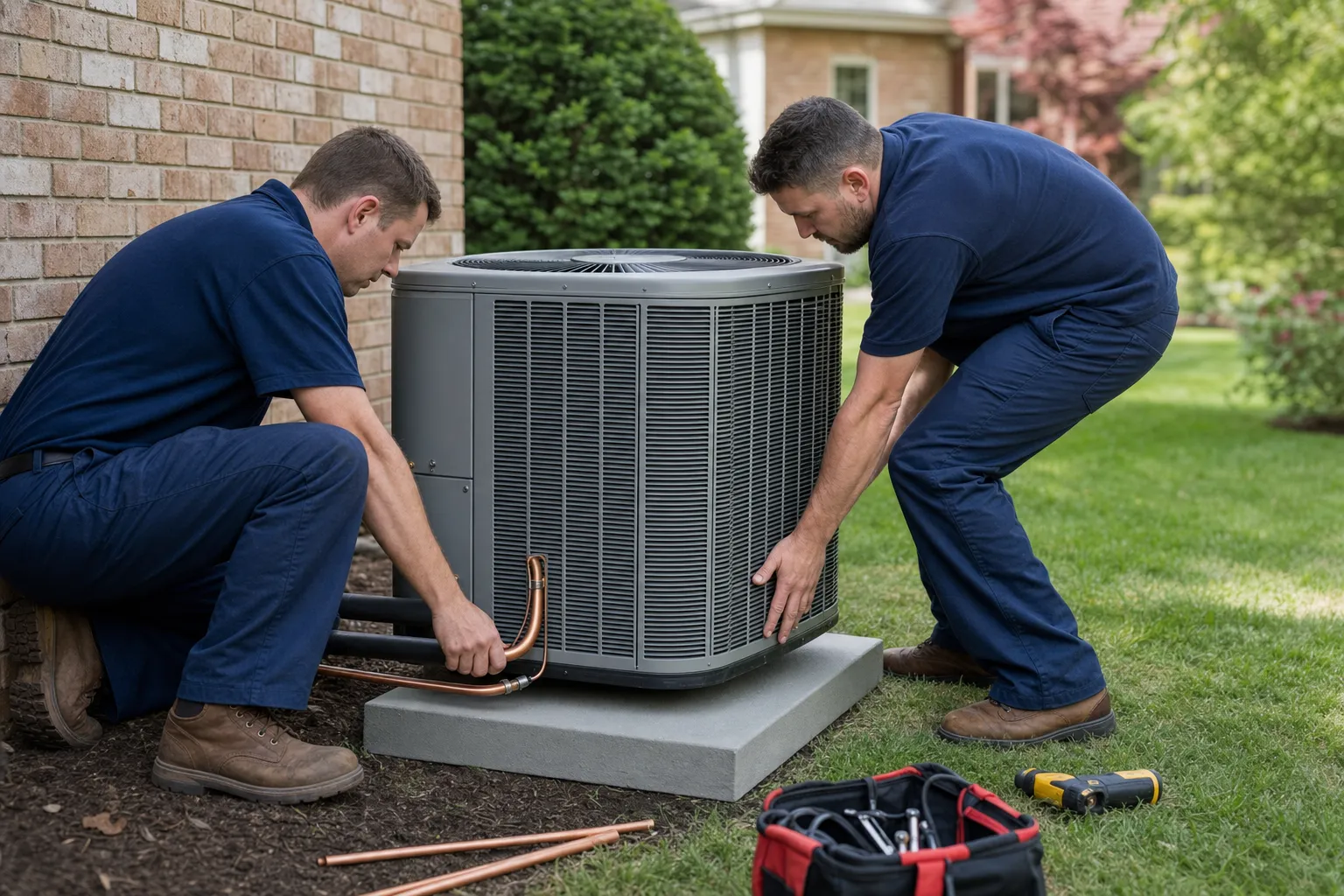
- Set the new outdoor condenser on the pad and make electrical connections.
- Install the new evaporator coil and connect to the air handler cabinet.
- Connect or replace the refrigerant line set between the indoor and outdoor units.
- Pressure test the refrigerant circuit to confirm no leaks before charging.
- Charge the system with the correct refrigerant type and amount per manufacturer specification.
- Start the system and verify operating pressures, temperature split across the coil, airflow, and thermostat function.
Each step has a reason. Pressure testing before charging is particularly important: a technician who skips it and charges refrigerant into a leaking system is setting up a callback in six months when the charge has bled off and the system is underperforming.
What the refrigerant line set decision involves
The refrigerant line set, the two copper pipes that connect the outdoor condenser to the indoor coil, is sometimes reused and sometimes replaced. Reusing an existing line set saves cost and time, but it is only appropriate if the existing lines are the correct diameter for the new equipment, undamaged, and properly insulated.
If the new condenser uses a different refrigerant than the old system, the existing line set almost always needs replacement, since residue from the old refrigerant oil can contaminate a new refrigerant circuit. Most equipment sold today uses R-410A or, in newer installations, R-454B, both of which are incompatible with the older R-22 systems that were standard before 2010. In a Bucks County home with equipment that dates to the early 2000s, replacing the line set is frequently the right call even if it adds a few hours to the job.
What affects how long the job takes
Most homeowners are told a replacement takes one day and plan accordingly. That is accurate for a straightforward swap with no complications, but several factors can extend the timeline. Understanding those factors helps you plan realistically and ask the right questions before scheduling.
The size and configuration of the home matters. A single-story ranch in Newtown is a different job than a three-story colonial in Doylestown with the air handler in the attic and the condenser on a second-floor deck. Accessibility, the length of the refrigerant line set, and whether any electrical upgrades are needed all affect the total time.
Jobs that take longer than a single day
Some replacements extend into a second day or require a follow-up visit. The most common reasons include:
- Air handler replacement in addition to the condenser and coil: adds several hours and sometimes requires more extensive duct connection work
- Electrical panel upgrade: if the existing panel cannot support the new equipment's amperage draw, a licensed electrician must upgrade the panel before the HVAC work can be completed
- Duct repairs or modifications: a duct system that needs re-routing, sealing, or resizing adds time proportional to the scope of work
- Permit inspection: in Bucks County municipalities, an inspection must be scheduled after installation, which may occur the following day or later
- Non-standard equipment configurations: attic installations, rooftop units, or systems requiring custom mounting add complexity
If a contractor quotes one day on a job that clearly involves several of these factors, ask how they plan to handle each one. A realistic timeline upfront prevents a half-finished installation from sitting overnight or longer.
The permit and inspection process in Bucks County
Pulling a permit for an AC replacement is a legal requirement in Bucks County municipalities, not an optional add-on. A contractor who offers to skip the permit to save time or cost is creating liability for the homeowner. If the work is done without a permit and a water or heating repair issue surfaces later that involves the HVAC system, an insurance claim can be denied on the basis that unpermitted work was involved.
The permit process requires the contractor to file before the work starts and schedule an inspection after completion. The inspection confirms that the installation meets local code requirements for electrical connections, refrigerant handling, equipment clearances, and drain line termination. It is an added step, but it also provides independent verification that the installation was done correctly, which is worth having on record.
Thermostat and accessory installation timing
If the replacement includes a new thermostat, a UV air purifier, or a whole-home dehumidifier, those components are typically installed on the same day as the main equipment. Smart thermostat setup, including Wi-Fi connection and scheduling configuration, adds time but is worth doing before the technician leaves rather than troubleshooting later.
Some homeowners use an AC replacement as the opportunity to add air conditioning accessories they have been considering, such as a whole-home dehumidifier for Bucks County's humid summers or a UV system for air quality. If those additions are part of the plan, confirm them with the contractor before the installation day so the parts are on the truck and the additional labor is factored into the timeline.
How to evaluate the finished installation and what happens after
When the installation is complete, there are several things worth verifying before the technician leaves. A well-run job ends with a proper startup and a walkthrough, not just a signature on an invoice. Knowing what to look for and what questions to ask makes that final step more productive.
The technician should start the system in your presence, allow it to run through a full cooling cycle, and walk through the operating pressures, temperature split, airflow, and thermostat behavior. Any issues that show up during that initial run are far easier to resolve while the crew is still on site than after they have loaded the truck and left.
What the startup check should confirm
A thorough startup check covers the full system, not just whether cold air is coming out of the vents. The technician should verify:
- Supply air temperature at a register, compared to return air temperature, to confirm the system is achieving proper temperature split
- Operating pressures on the refrigerant circuit, matched against manufacturer specifications for that equipment and refrigerant type
- Airflow at supply registers, which confirms the duct system is delivering air to the right zones without obstruction
- Condensate drain operation, including the float switch if one is installed
- Thermostat staging behavior, including how the system responds to a call for cooling and how it stages down when the setpoint is reached
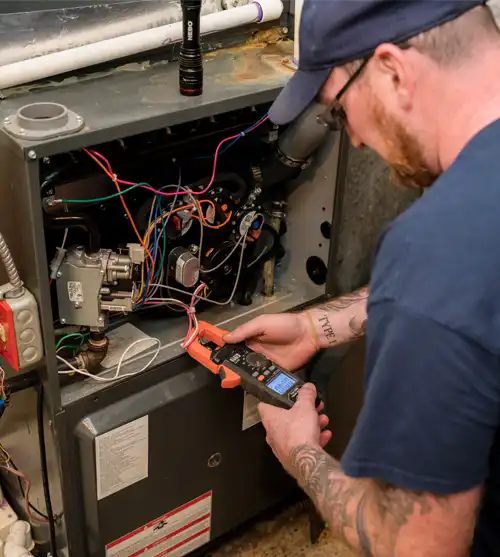
- Electrical connections at the disconnect, breaker, and unit terminals
If any of these checks produces a reading outside the expected range, the technician should identify and correct the cause before the job is closed out. A refrigerant charge that is slightly off, or a duct connection that was not fully seated, is a minor correction at startup and a service call six weeks later.
The warranty registration and documentation you need
After a replacement, two sets of documentation matter: the manufacturer's equipment warranty and the contractor's labor warranty. Most manufacturers offer a base warranty of five to ten years on parts, which extends to ten or twelve years if the equipment is registered online within a specified window after installation, typically 60 to 90 days.
The contractor should provide a written invoice that includes the equipment model and serial numbers, the installation date, the refrigerant type and charge amount, the permit number, and the labor warranty terms. Keep that document with your home records. If the system needs service within the warranty period, that paperwork determines what is covered and by whom. For a high-efficiency system that can reduce cooling energy use by up to 20 percent over its lifetime, getting the registration right on day one is worth five minutes of attention.
Scheduling the first maintenance visit
A new system does not eliminate the need for annual maintenance; it resets the clock on when maintenance matters most. The first professional tune-up on a new installation should happen one year after installation, before the second cooling season begins. That visit confirms that refrigerant charge, coil condition, and drainage are all holding at the levels they were at startup.
Homeowners should also plan to replace the air filter every one to three months depending on household conditions. Pets, renovation activity, and dusty duct systems all accelerate filter loading, and a clogged filter is one of the fastest ways to reduce the efficiency and shorten the service life of equipment that was just installed. In Willow Grove or anywhere else in the Philadelphia suburbs, a new system that gets consistent basic care reaches its full 15 to 20 year service life. One that does not gets replaced earlier.
Conclusion
An AC replacement in Bucks County is a significant investment, and the outcome depends more on how the job is done than on which brand of equipment gets installed. Proper sizing with a Manual J calculation, accurate refrigerant line set decisions, a code-compliant permit and inspection, and a thorough startup check are what separate a system that performs well for 15 years from one that causes problems in the first three.
Understanding the process before scheduling puts you in a better position to evaluate contractors, ask the right questions, and recognize when something is being skipped that should not be. The homeowners who have the best experiences with HVAC replacements are almost always the ones who went into the project informed rather than reactive.
When you are ready to move forward, contact Guaranteed Plumbing & Heating to schedule a consultation and get the installation done right from the start.