



Why your thermostat may be raising cooling costs in Philadelphia homes
Your thermostat settings have more control over your summer PECO bill than almost anything else in your home, and the most costly mistakes are ones most Philadelphia homeowners make every day without knowing it. A degree here, a wrong schedule there, and by the end of August you are staring at a bill that does not make sense. The fix is usually simple, but you have to know what you are dealing with first.
Philadelphia summers hit hard. The combination of heat, humidity, and back-to-back heat waves means your air conditioning runs longer than it would in most of the country. On top of that, PECO rates have climbed steadily.
According to WHYY, the typical monthly residential PECO bill rose to $160.37 in January 2026, following consecutive rate increases through 2025 that pushed combined utility costs about $30 per month higher for Philadelphia households. When your thermostat is working against you on top of rising rates, the damage to your monthly bill adds up fast.
Understanding why your thermostat drives up cooling costs is the first step. The second is knowing which adjustments actually move the needle and which ones are myths. This article covers both.
In this article, you will learn about:
- The thermostat settings that consistently drive up cooling costs
- How placement and calibration affect what you are actually paying
- The real difference between manual, programmable, and smart thermostats
- What the right cooling schedule looks like for a Philadelphia summer
Keep reading to find out exactly where your thermostat is costing you money and how to take back control of your PECO bill.
Setting it too low is the single biggest mistake
This is the one that catches the most Philadelphia homeowners off guard. When it is hot outside, the instinct is to crank the AC down to 68 or 70 degrees to cool the house down faster. The problem is that a central air system does not cool faster because you set the thermostat lower. It runs at the same speed regardless, and a lower target just means longer run times, which translates directly into a higher bill.
The U.S. Department of Energy recommends 78 degrees as the optimal summer setting when you are home and awake. That number is not arbitrary. It is the point where most people stay comfortable without the system working harder than it needs to. For every degree you set below that threshold for an extended period, you are adding runtime and cost.
Why 68 degrees costs so much more than 78
The math on this is straightforward once you see it. According to the Pennsylvania Public Utility Commission, homeowners can save up to 3% per degree by adjusting the thermostat from a baseline of around 78 degrees during summer. That means running at 68 instead of 78 could be adding 20 to 30 percent to your cooling costs every month.
In a Philadelphia summer that runs from June through September, those extra degrees compound across four months. A household already paying $160 a month for electricity does not have to go far before a thermostat set too low becomes a several-hundred-dollar seasonal mistake.
The fix is not about suffering through the heat. It is about understanding that your system cools at a fixed rate and setting a realistic target that lets it reach equilibrium rather than chasing a temperature the house cannot hit efficiently.
The comfort gap between setting and feeling
One thing that confuses homeowners is that a 78-degree setting does not always feel like 78 degrees, and that gap sometimes drives them to keep pushing the number lower. If the air in your home feels warmer than the thermostat says, the thermostat reading might be accurate but your comfort is being pulled down by humidity.
Air that holds a lot of moisture feels warmer at the same temperature as dry air. On humid summer days in Philadelphia, your AC has to remove a significant amount of moisture from the air before the temperature reading even feels accurate to your body.
Summer humidity affects AC performance in ways that a thermostat setting alone cannot fix. This is normal, but it means that running the system longer and colder is not always the solution. Addressing heating repair issues that reduce system efficiency, or having a technician check refrigerant levels and coil condition, often does more for comfort than dropping the thermostat two more degrees.
Short-cycling and what low settings do to your equipment
There is a mechanical cost to low thermostat settings beyond the electricity bill. When you set a very low target on a hot day, your system may run continuously without ever reaching that temperature, a condition sometimes called short-cycling or continuous operation. Long, unbroken run cycles stress the compressor and increase wear on the system.
Over time, a system that is constantly chasing an unreachable temperature will need repairs sooner and fail earlier than one running efficient cycles. For Philadelphia homeowners dealing with pipe repair and repiping or other home systems, adding premature HVAC wear to the repair list is a cost most people would rather avoid.
Where your thermostat is located matters as much as what it is set to
A thermostat reads the air temperature around it and triggers your system based on that reading. If the thermostat is sitting in a bad location, it is making decisions based on air that does not represent the rest of your home. This is one of the most underdiagnosed causes of high cooling costs and uneven comfort in older Philadelphia row homes and twins.
The most common problem location is a wall that gets direct afternoon sun. When sunlight heats that wall, the thermostat reads higher than the actual room temperature and runs the AC longer than necessary. You end up cold and still overpaying.
Vents, doors, and drafts that throw off readings
Supply vents positioned too close to the thermostat push conditioned air directly over the sensor. The thermostat reads that cooled air as the room being at the target temperature and shuts the system off, even though the rest of the house is still warm. The system cycles off too early, rooms stay warm, and then the cycle restarts. The result is a system running in short bursts that never fully conditions the space.
Door and window drafts create similar problems. A thermostat near a leaky window in one of Philadelphia's older row homes may be reading a mix of outdoor air and indoor air. During a heat wave, that draft reads hot and the system never shuts off. During a cool evening, the thermostat gets fooled into thinking the house is comfortable when it is not.
The emergency plumber in Philadelphia calls that come in during heat waves are sometimes traced back to an overworked system that was running around the clock because of a bad thermostat location or a calibration issue, not a mechanical failure.
Checking whether your thermostat is reading accurately
The simplest field check is to tape a reliable thermometer next to your thermostat for an hour while the system is off. If the reading differs by more than a degree or two from what your thermostat displays, the thermostat may need calibration or replacement. Old mercury-switch thermostats in particular tend to drift over time.
Most thermostats installed in Philadelphia homes built before the mid-2000s are either mercury-switch or basic digital units that were never designed for energy management. Replacing one is a relatively low-cost change that can have a measurable effect on your monthly bill.
The best location for a thermostat in a Philadelphia row home
In a typical Philadelphia rowhouse, the interior first-floor hallway is usually the most representative location for a thermostat. It is away from direct sunlight, away from supply vents, and roughly central to the living area. The worst common locations are south or west-facing exterior walls, above kitchen appliances that generate heat, near staircases with strong draft patterns, and directly above or below an HVAC supply register.
For homes in Fox Chase, Mayfair, Rhawnhurst, and similar Northeast neighborhoods where rowhouse layouts follow similar floor plans, the placement problem tends to repeat in the same spots. If your thermostat location has not been evaluated since the system was last replaced, a technician checking the system can confirm whether it is where it should be. A few minutes spent on this question can influence how the system behaves all summer.
Ignoring schedules means your AC runs when no one is home
This is where the biggest consistent waste happens for working households. If you leave the house at 8 a.m. and come back at 6 p.m., and your thermostat is holding 72 degrees all day to an empty house, you are paying to cool rooms with no one in them for ten hours straight. Across a five-day work week through a Philadelphia summer, that adds up quickly.
According to ENERGY STAR, setting your thermostat back 7 to 10 degrees from its normal setting for 8 hours a day can save up to 10% on your annual heating and cooling costs. For many Philadelphia households paying $150 or more per month in summer electricity costs, that 10% represents real money.
Getting there does not require a smart thermostat. A basic programmable model works, as long as it is actually programmed.
The programmable thermostat that nobody programs
Studies have consistently found that a large share of homeowners who own a programmable thermostat never set up the programming. The device is installed, it holds a single temperature 24 hours a day, and it provides exactly zero benefit over a manual dial. This is the most common thermostat situation in Philadelphia row homes.
Setting up a basic schedule takes about ten minutes. The rough logic for a typical weekday:
- Set the thermostat to 78 when you leave for work.
- Drop it to 75 or 76 about 30 minutes before you normally get home.
- Hold 76 through the evening.
- Allow it to drift to 80 overnight while you sleep with a fan.
That single schedule, applied consistently, is where most of the programmable thermostat savings come from. You do not need advanced features.
What a smart thermostat actually adds
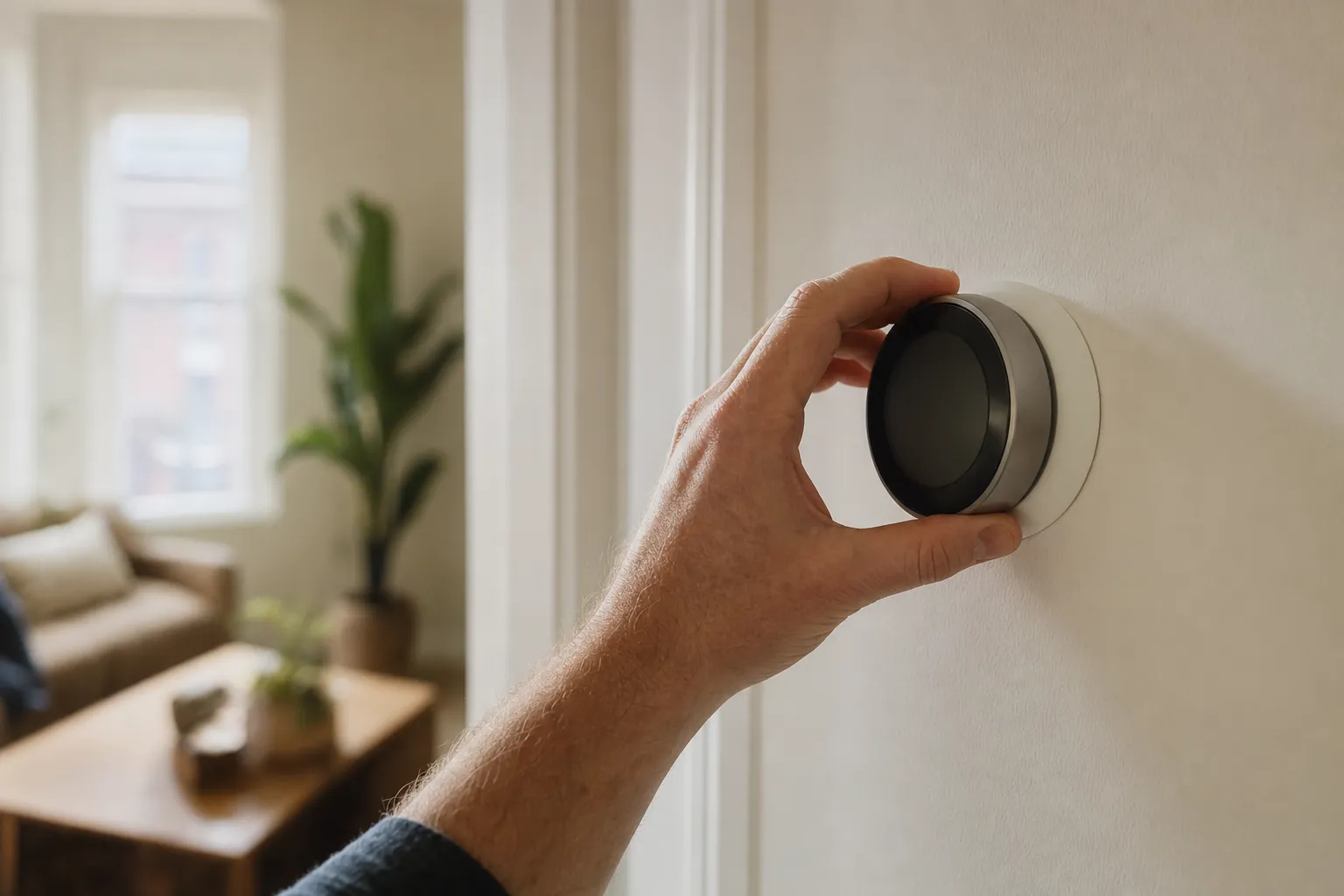
Smart thermostats go further by learning your patterns, detecting when the house is empty through geofencing, and adjusting automatically. According to the ENERGY STAR smart thermostat certification program, certified smart thermostats save an average of 8% on annual heating and cooling costs. For homes in Philadelphia's summer climate, cooling savings are typically the larger share of that figure.
The practical difference between a programmed programmable thermostat and a smart thermostat is mostly about automation and remote access. A smart thermostat handles the schedule without you having to think about it. If your household has irregular schedules or if people are home at unpredictable times, the self-adjusting feature closes the gap that manual programming can leave open.
Neither type saves money on its own. The schedule has to match your actual patterns, and the system it controls has to be in good working order. A smart thermostat connected to a system running at reduced capacity because of a drain cleaning and hydro jetting issue affecting a condensate line, or worn parts that have not been serviced, will still underperform.
How zoning changes the equation in larger Philadelphia homes
Single-zone thermostats control the temperature of an entire home from one sensor. In a three-story rowhouse or a twin with an attached garage, that setup means you are heating or cooling the full volume of the house to satisfy one reading. Rooms that are always occupied get the same treatment as rooms that rarely are.
Zoning systems let you split the home into independent temperature zones, each with its own thermostat. For larger Abington or Glenside properties where finished basements, sunrooms, or upper floors are in regular use, this approach lets you direct cooling where it matters and reduce it where it does not. If you have questions about plumbing services in Abington or surrounding areas, the same service call can often address whether a zoning upgrade makes financial sense for your setup.
A thermostat can't fix an inefficient system
This is the part most homeowners skip over. All the thermostat optimization in the world does not compensate for a system that is running inefficiently. If your AC is low on refrigerant, has a dirty evaporator coil, or is running a clogged air filter, the system is doing more work per degree of cooling than it should. The thermostat is accurately tracking the temperature, the problem is just that the system cannot respond efficiently to what it is asking for.
This is why some households do everything right with their thermostat settings and still see bills that seem too high. The thermostat is the control mechanism, but the actual cost driver is how much electricity the system uses to produce each degree of cooling.
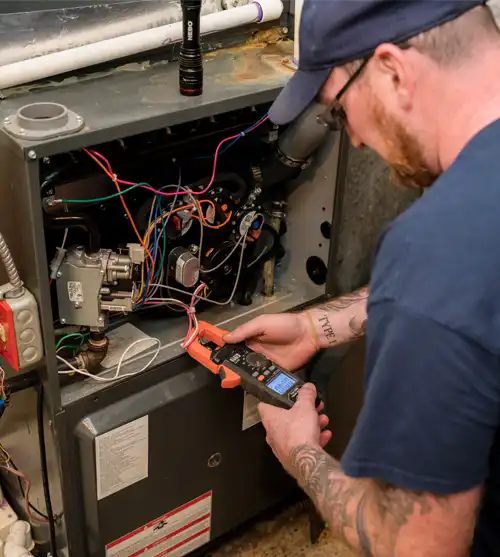
Annual HVAC maintenance before the cooling season starts addresses this directly. A technician checks refrigerant levels, cleans coils, inspects the blower and capacitors, and makes sure the system is ready to run efficiently when demand is highest.
Air filter neglect and what it does to your bill
The most common and least expensive cause of reduced cooling efficiency is a dirty air filter. A clogged filter restricts airflow, which forces the blower to work harder and reduces the amount of cooled air that actually reaches your living spaces. The system runs longer to hit the target temperature, which drives up the bill.
In Philadelphia, where summer can bring weeks of high-pollen counts and elevated particulates, filters in active households should be checked monthly and replaced at a minimum every 60 to 90 days. Many homeowners are running on filters that have not been changed since early spring.
The signs are not always obvious until you check:
- Higher-than-normal electric bills with no change in usage habits.
- Rooms that take longer than usual to reach the set temperature.
- The system running almost continuously on days that are not even that hot.
- Visible gray or brown buildup on the filter when you pull it out.
Duct leaks that undermine every setting you make
Even a well-calibrated thermostat running on a clean, efficient system loses ground to duct leaks. In Philadelphia row homes, ductwork often runs through unconditioned attic spaces or basement areas. Joints that have separated or gaps that were never sealed let conditioned air escape before it reaches the rooms you are trying to cool.
When air leaks out of the duct system, the thermostat does not know it. From the thermostat's perspective, the system is running and the temperature has not hit the target yet, so it keeps calling for more cooling. The result is a system running longer cycles than it should while delivering less comfort. If the ductwork in your home has never been tested or sealed, it may be one of the larger contributors to your summer bill.
A related issue is an incorrectly sized system installed during a previous renovation. An undersized unit runs constantly without reaching the set temperature. An oversized unit short-cycles, blasting the thermostat location with cold air while distant rooms stay warm. Either condition can make it look like the thermostat is broken when the real issue is whether you replace your air conditioner or repair what you have. Both conditions make a thermostat look like it is malfunctioning when the real issue is equipment sizing.
When to call a professional instead of adjusting settings
Some cooling problems cannot be resolved by changing the thermostat settings. If you have tried adjusting the schedule, confirmed the filter is clean, and the system still cannot hold the target temperature during a Philadelphia summer storm or heat wave, the issue is in the equipment. A system that runs continuously without cooling, that trips the circuit breaker under load, or that produces warm air from the vents needs a professional diagnosis.
The plumbing repair and service work that comes alongside cooling system calls often reveals issues that have been compounding quietly, condensate drain clogs that cause water damage, secondary pan overflows, and related problems that are cheaper to address before they cause structural damage. Getting ahead of the issue before peak summer heat is almost always the right move for Northeast Philadelphia homeowners dealing with the one-two punch of high utility rates and aging equipment.
Conclusion
Your thermostat is one of the most powerful tools you have for managing summer cooling costs, but only when it is set correctly, located well, and connected to a system that is running efficiently. Setting the temperature too low, skipping the schedule, and ignoring maintenance are the three habits that consistently add the most to Philadelphia PECO bills from June through September. Each one is fixable without major expense, and fixing all three together can make a real difference by August.
The other side of the equation is the system itself. A thermostat cannot save money when the equipment behind it is struggling with a dirty coil, a clogged drain, or a refrigerant issue. Regular maintenance keeps the system ready to respond efficiently to whatever your thermostat is asking for.
If your home is running harder than it should this summer, or if you want a professional eye on whether your HVAC setup is as efficient as it could be, Guaranteed Plumbing & Heating has been serving Philadelphia and the surrounding area since 1990. Call 215-342-7200 to schedule a visit and start cutting into those summer cooling costs.