



How AC maintenance prevents costly breakdowns in Montgomery County homes
How AC maintenance prevents costly breakdowns starts with understanding what actually happens inside a system that never gets serviced. In Montgomery County, where summers push well into the 90s and older housing stock means plenty of aging equipment, a skipped tune-up rarely stays invisible for long. Systems that run hard without periodic attention develop small inefficiencies that compound into bigger failures.
Most AC breakdowns do not happen out of nowhere. Capacitors weaken over months before they fail. Drain lines collect debris and then stop draining. Coils accumulate a layer of grime that gradually forces the compressor to work harder. Each of those issues is inexpensive and fast to address during a scheduled maintenance visit. Left alone, each one eventually causes an emergency call on the hottest day of the summer.
For Montgomery County homeowners in Abington, Glenside, Horsham, or Willow Grove, the math is straightforward. A yearly tune-up costs a fraction of what a compressor replacement or an emergency weekend service call runs. The difference is almost entirely about getting ahead of the problem rather than reacting to it.
In this article, you will learn about:
- What a professional AC tune-up actually covers
- The components most likely to fail without regular service
- How maintenance affects energy bills and system lifespan
- Signs your system is overdue for attention
Keep reading to learn how routine maintenance protects your cooling system and keeps summer from turning into a repair emergency.
What a professional AC tune-up actually covers
A lot of homeowners assume a tune-up is mostly about checking refrigerant, but that is a small part of a complete inspection. A thorough maintenance visit covers the full system, from the air handler inside the house to the condenser unit outside, and it produces a clear picture of where the system stands heading into the cooling season.
The goal is not to find one thing wrong and fix it. The goal is to assess every component that degrades over time, clean the ones that need it, test the ones that can fail, and identify anything that warrants a repair before it becomes an emergency. In older homes throughout the Philadelphia suburbs, that kind of full-system look catches issues that would otherwise go unnoticed until they cause a breakdown.
The inspection checklist most homeowners never see
A standard tune-up covers more ground than most homeowners expect. The technician works through both the indoor and outdoor units, checking mechanical components, electrical connections, refrigerant charge, airflow, and drainage.
A complete visit typically addresses:
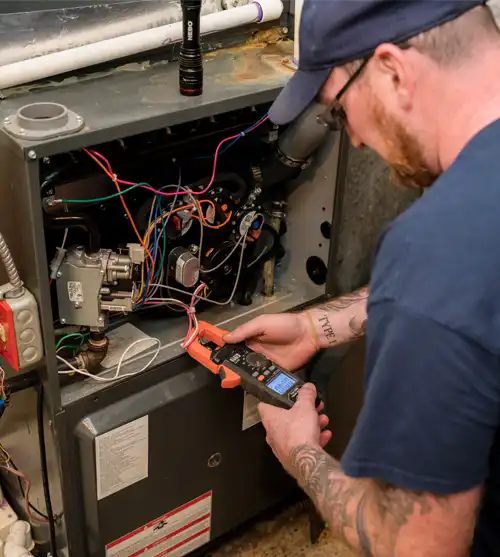
- Electrical connections and capacitor voltage readings
- Contactor condition and contact gap
- Evaporator and condenser coil cleanliness
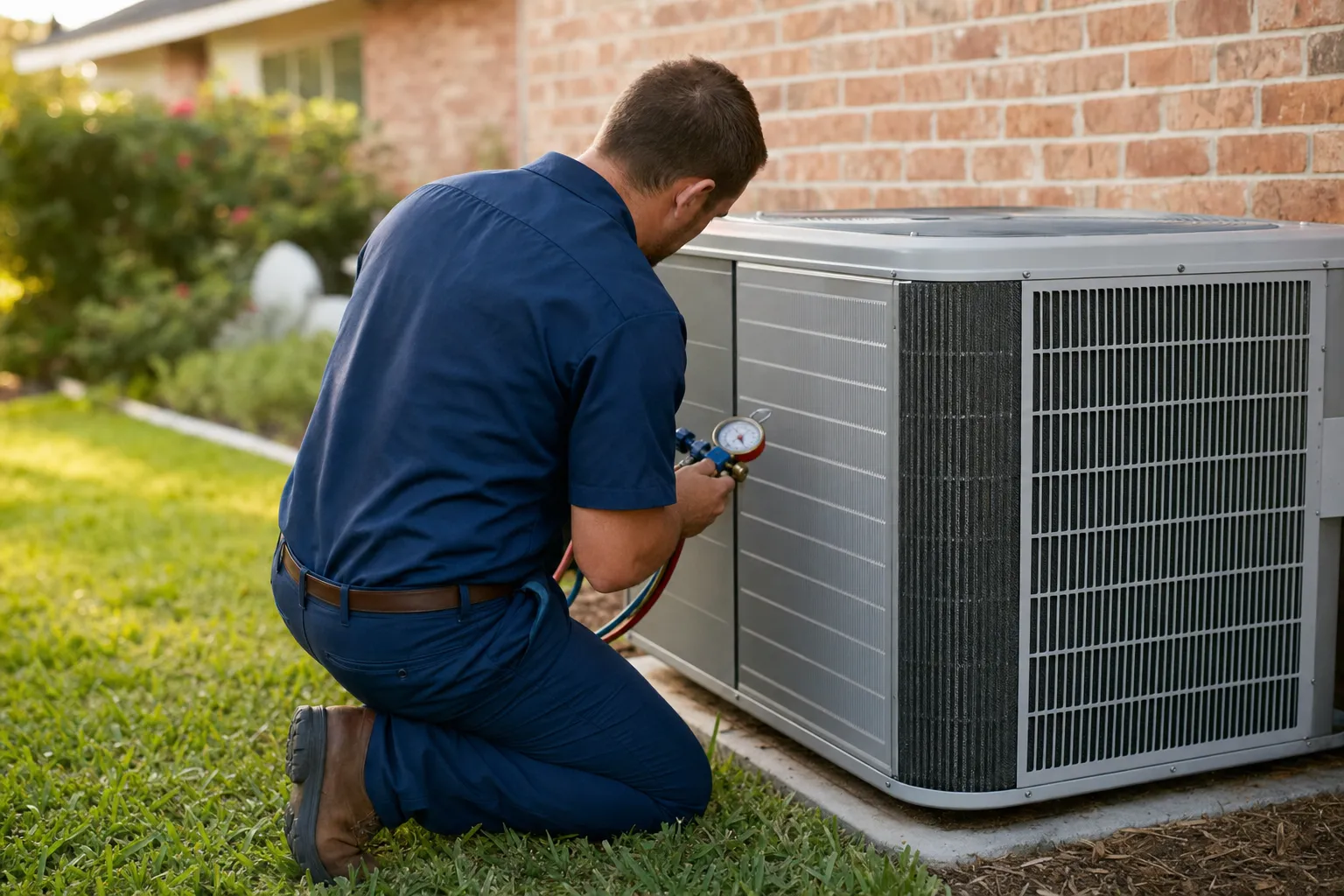
- Refrigerant pressure and temperature split across the coil
- Condensate drain line flush and float switch test
- Blower motor amperage and belt condition (belt-drive systems)
- Air filter condition and replacement if needed
- Thermostat calibration and staging behavior
- Outdoor unit clearance and coil fin straightening
Each of these items affects either efficiency, reliability, or both. A technician who works through the full list leaves a system in measurably better shape than it was before the visit, and typically leaves the homeowner with a clearer picture of what the system's remaining service life looks like.
Why refrigerant is checked last, not first
One of the most common misconceptions about AC maintenance is that refrigerant is the first thing a technician checks. In practice, refrigerant should be evaluated after everything else because most efficiency problems trace to airflow and coil condition, not refrigerant charge.
A clogged filter or dirty evaporator coil produces symptoms that look like low refrigerant: poor cooling, elevated run times, coil icing. If a technician adds refrigerant without first diagnosing airflow issues, the system may still underperform and the homeowner pays for refrigerant that was not the actual problem. Correct diagnostic order is part of what separates a thorough AC maintenance visit from a quick check.
What happens to a system that skips annual service
A system that goes without service for several years accumulates problems across multiple components at once. Coils get dirtier. Capacitors weaken. Drain lines develop blockages. Each issue adds a small amount of strain, and the compressor, the most expensive component in the system, absorbs all of it.
According to NIST Technical Note 1848, improper installation and maintenance increase household HVAC energy use by 30 percent or more compared to properly maintained systems. That 30 percent gap is not the result of one neglected component; it is the cumulative effect of a system running in a degraded state across every part of the equipment simultaneously.
The components most likely to fail without regular service
Not every part of an AC system fails at the same rate. Some components wear predictably and can be caught during a tune-up. Others fail suddenly, but their failure is almost always preceded by measurable signs that a technician finds during an inspection. Understanding which parts carry the highest risk helps explain why preventive service is worth scheduling before the season starts rather than waiting until a problem appears.
In Montgomery County homes, the combination of hot, humid summers and heating seasons that stress the equipment in both directions creates a pattern of wear that shows up consistently in certain components. Capacitors, drain lines, and coils account for the majority of AC failures that could have been caught before they happened.
Capacitors: the most common reason AC systems stop cooling
A capacitor stores and releases the electrical charge that starts the compressor and fan motors. It degrades slowly with each use, and its voltage gradually falls below the threshold the motors need to start properly. When a capacitor reaches the end of its service life, the motor it serves either starts sluggishly, trips a safety breaker, or stops starting at all.
The failure mode is predictable, and the component is inexpensive. A capacitor typically costs under a hundred dollars in parts and takes under thirty minutes to replace during a maintenance visit. The same repair as an emergency call on a weekend in July, when the system has stopped cooling entirely, runs two to three times that cost in labor alone, assuming you can get a technician out the same day. Catching a weak capacitor during a spring tune-up is one of the clearest examples of how preventive maintenance pays for itself.
In Montgomery County homes that have not been serviced in several years, weak capacitors are one of the first things a technician checks. A capacitor tester gives an immediate reading of whether the component is operating within spec or approaching failure, and that information drives a straightforward recommendation.
Condensate drain lines and the water damage they cause
An AC system removes moisture from the air as it cools, and that moisture drains out of the indoor air handler through a condensate line. During a Montgomery County summer, a functioning system pulls significant humidity out of the air every day. When the drain line develops an algae or debris blockage, that water backs up into the drain pan and eventually overflows into the ceiling, wall, or floor below the air handler.
Water damage from a blocked condensate line is one of the more avoidable emergency plumbing and HVAC repair situations a homeowner can face. The repair cost is not just the HVAC service call; it includes anything the water damaged on the way down. Drywall, insulation, flooring, and in some cases structural framing can all be affected before a homeowner notices the problem.
A maintenance visit includes flushing the drain line and testing the float switch, which is the safety device that shuts the system down before the pan overflows. Both steps take minutes and reliably prevent the kind of water damage that takes days to remediate.
Coil fouling and what it does to your energy bill
Both the evaporator coil inside the air handler and the condenser coil in the outdoor unit accumulate grime over time. The evaporator coil picks up dust and particulate that passes through the filter; the condenser coil collects cottonwood, grass clippings, and general outdoor debris. A film of buildup on either coil reduces the heat transfer efficiency the system depends on to cool the air.
The U.S. Department of Energy reports that a clogged evaporator coil can reduce cooling capacity significantly and that proper maintenance, including keeping coils clean, can cut household air conditioning energy use by 5 to 20 percent annually. For a Montgomery County home running central air through a full summer, that range represents a real dollar figure. A system with dirty coils is not just less comfortable; it is more expensive to operate every single day the system runs.
Coil cleaning is a standard part of a professional tune-up. It is also one of the items most likely to be skipped during a quick service call that focuses only on refrigerant. A thorough visit addresses both coils, which is why the scope of the maintenance visit matters as much as its frequency.
How maintenance affects energy bills and system lifespan
The financial case for AC maintenance rests on two numbers: what the system costs to run each month and how long it lasts before it needs replacing. Both are directly influenced by whether the system gets regular service. A maintained system runs more efficiently and reaches the upper end of its expected service life. A neglected system runs harder, costs more per month to operate, and fails earlier.
For Montgomery County homeowners, HVAC is typically one of the largest single categories of household energy spending, especially during summer cooling season. Gains in efficiency from routine maintenance are not theoretical; they show up in monthly utility bills. And the difference between a system that lasts 15 years and one that lasts 10 is the cost of one full replacement earlier than necessary.
The energy efficiency gap between maintained and unmaintained systems
The U.S. Environmental Protection Agency notes that well-maintained heating and cooling systems use 5 to 15 percent less energy than poorly maintained ones. That figure aligns with what the Department of Energy documents across residential maintenance programs: savings of 5 to 20 percent annually are consistently achievable when systems are properly tuned and cleaned.
For a household spending several hundred dollars a month on cooling during a Montgomery County summer, a 10 to 15 percent reduction is not trivial. Over a cooling season, that is a meaningful amount back in the homeowner's pocket without any change to comfort or thermostat settings. The savings come entirely from the system running the way it was designed to rather than fighting through accumulated wear.
It is also worth noting that these efficiency gains are cumulative with filter maintenance. Replacing the air filter regularly, which is a task homeowners can handle between professional visits, contributes its own measurable reduction in energy draw. A clean filter and a professionally serviced system compound the savings.
How regular maintenance extends equipment life
A properly maintained AC system reaches the upper range of its expected service life, typically 15 to 20 years for central air systems in residential applications. A system that never gets serviced tends to fail earlier, often in the ten-to-twelve-year range, as accumulated wear on components like the compressor, blower motor, and refrigerant circuit shortens the system's useful life.
The Department of Energy states that regular maintenance is one of the primary factors in extending equipment lifespan and avoiding premature replacement. For a Montgomery County homeowner, the cost difference between a system that lasts 10 years and one that lasts 18 is a full equipment replacement and installation, which runs several thousand dollars for a standard central air system. Preventive maintenance does not eliminate the eventual need to replace equipment, but it consistently pushes that date further out.
There is also a warranty dimension. Most HVAC manufacturers require documented annual maintenance to keep the equipment warranty valid. A system that fails without a maintenance record may be denied warranty coverage even during the coverage period, leaving the homeowner responsible for the full repair or replacement cost.
Scheduling timing and why spring is the right window
The optimal time to schedule a tune-up for a central air system in Montgomery County is late spring, before the first sustained heat of the season. April and May allow a technician to catch any issues that developed over the winter and get the system into proper working order before it starts running daily.
Scheduling in spring also avoids the summer rush. HVAC companies in the Philadelphia area are fully booked during heat waves, and an appointment that was easy to get in May becomes a multi-day wait in July.
A homeowner who schedules a heating repair or AC tune-up proactively before the peak season avoids both the scheduling delay and the premium pricing that emergency service commands. The system is serviced, the appointment was easy to schedule, and the summer starts without uncertainty about whether the equipment is ready.
Signs your system is overdue for attention
Some signs of a neglected AC system are obvious: it stops cooling, the breaker trips, or the drain pan overflows. But most of the warning signals that precede a breakdown are subtler. A system that is heading toward failure usually shows its hand over several weeks before anything dramatic happens. Recognizing those signals, especially heading into a Montgomery County summer, is the difference between a tune-up and an emergency repair.
The signs below are not always caused by deferred maintenance specifically, but they are all worth investigating before the cooling season is fully underway. Each one points to a component or condition that a professional inspection can evaluate and, in most cases, address during the same visit.
These are the patterns most worth paying attention to:
- Longer run cycles to reach the set temperature, which points to reduced efficiency from dirty coils or weak refrigerant charge
- Higher electric bills compared to the same period last year with similar usage patterns
- Uneven cooling between rooms on the same floor, which can indicate a duct issue or blower problem
- Unusual sounds during startup, including clicking, humming, or rattling that was not present before
- Visible moisture around the air handler or a musty odor from the vents, which often traces to a drain issue or coil problem
- The system short-cycling, meaning it turns on and off rapidly without completing a full cooling cycle
None of these symptoms require waiting to see if they get worse. Each is worth a call before the system fails during a heat wave.
When a warning sign becomes an emergency
Some conditions move from symptom to failure faster than others. A capacitor running below spec may work for weeks before it fails completely; a blocked drain line may overflow in a matter of hours once it reaches a full blockage.
Homeowners who notice warning signs their AC needs repair tend to describe the same pattern: a sign appeared, they planned to get it looked at, and the system failed before they made the call.
The practical takeaway is that a symptom noticed in spring is worth addressing before summer. A symptom noticed during a July heat wave is already an emergency. The same underlying issue, addressed at different points in the timeline, can be a hundred-dollar maintenance fix or a thousand-dollar emergency repair depending entirely on when the call gets made.
What to tell a technician when you schedule
When calling to schedule a maintenance visit, a few pieces of information make the appointment more productive. Knowing the approximate age of the system, whether it has ever been serviced, and whether you have noticed any of the warning signs above gives the technician context before they arrive.
If the system is more than ten years old and has not been regularly maintained, be prepared for the visit to surface more than just cleaning and capacitor checks. Older systems in the Montgomery County area, particularly in homes in Abington or Glenside with original equipment, sometimes reveal multiple deferred issues during a first thorough inspection. That is not a failure of the visit; it is exactly what the visit is designed to find. Addressing several small issues at once is still far less expensive than replacing a system that could have been kept running for additional years.
Conclusion
AC maintenance in Montgomery County is not a suggestion. It is the primary way homeowners protect an expensive piece of equipment from avoidable failures and keep energy costs from climbing each summer. Capacitors weaken, drain lines clog, coils accumulate grime, and every one of those issues is inexpensive to fix during a scheduled visit and significantly more expensive to fix as an emergency repair.
The pattern is consistent: systems that get annual service last longer, run more efficiently, and break down less often than systems that do not. The savings show up in monthly energy bills, in avoided emergency service calls, and in the years added to the equipment's lifespan. For a Montgomery County homeowner, that adds up to a real return on a modest yearly investment.
Do not wait for a heat wave to find out what your system needs. Contact Guaranteed Plumbing & Heating to schedule an AC tune-up and start the cooling season with a system that is ready to run.