



Signs your plumbing needs repair before major damage in Bucks County homes
The signs your plumbing needs repair rarely show up all at once. More often, they start small: a drain that takes a few extra seconds, a faucet that drips overnight, a water bill that climbs just enough to notice. In Bucks County, where a lot of the housing stock dates back decades, those small signals tend to carry more weight than they might in a newer development.
Older homes in Levittown, Doylestown, and Langhorne were built when galvanized steel and clay sewer lines were the standard. Those materials have a lifespan, and for a lot of Bucks County properties, that lifespan is running out. What starts as a minor drip or a slow drain can turn into burst pipe damage, foundation seepage, or a sewage backup in the time it takes to get through a busy month.
The good news is that most major plumbing failures give you a warning first. Learning to read those warnings is what separates a hundred-dollar repair from a ten-thousand-dollar restoration job.
In this article, you will learn about:
- Low water pressure and what it tells you about your pipes
- Slow drains and what is really causing them
- Visible water damage and the leaks behind it
- Warning signs inside your water heater
Keep reading to learn how to catch plumbing problems before they turn into structural damage.
Low water pressure is never just an annoyance
Water pressure that drops noticeably in one or more fixtures is one of the most reliable early indicators of a developing plumbing problem. Some homeowners chalk it up to municipal supply variation, but if the drop is consistent, it usually points to something inside the house.
The most common causes in Bucks County homes are partial blockages in older galvanized supply lines, a failing pressure regulator, a corroding fitting at the water main connection, or a pinhole leak somewhere in the supply line that is bleeding off pressure before it reaches your fixtures. In homes built in the 1950s through the 1970s, galvanized steel pipes corrode from the inside out, gradually narrowing the interior diameter until water flow is visibly reduced.
When pressure drops in one room versus the whole house
A pressure drop in a single bathroom or kitchen typically points to a localized issue, either a clogged aerator, a partially closed shutoff valve, or a section of pipe that needs repair. That is a smaller job with a more contained fix.
When pressure drops throughout the house simultaneously, the source is likely closer to the main supply line, the pressure regulator, or the water meter connection. That is a more urgent situation and warrants a call to a plumber before you lose water service entirely.
Signs a pressure regulator is going
A pressure regulator controls the force at which municipal water enters your home. When it starts to fail, pressure fluctuates rather than holding steady. You may notice surging pressure one moment and weak flow the next. Banging sounds when a faucet shuts off, called water hammer, often accompany a failing regulator. Left unaddressed, the irregular pressure can stress fittings and joints throughout the house, accelerating wear on pipes that were already aging.
How corrosion inside galvanized pipes reads on the outside
You may not be able to see the inside of your pipes, but galvanized corrosion often leaves clues. Reddish or brownish tinting in the water when you first run a tap in the morning is a direct sign of rust moving through the line. Staining around fixture drains or on porcelain surfaces is another. In Bucks County plumbing calls involving low pressure, galvanized corrosion is one of the first things a plumber will check in a home older than 40 years.
Slow drains and what is really happening below the surface
A single slow drain is usually a clog. Multiple slow drains across different fixtures at the same time, or a drain that keeps backing up after you have cleared it, points to something farther down the line.
According to the U.S. Environmental Protection Agency, the average household loses more than 9,300 gallons of water annually from household leaks and drainage issues, with nine percent of homes losing 50 gallons or more per day. In homes where drainage problems compound over time, the wasted water is only part of the cost.
These patterns can help you identify how serious the problem is:
- A single slow drain: usually a hair, grease, or soap buildup at or near the fixture trap
- Multiple slow drains on the same floor: likely a partial blockage in a shared drain line
- Slow drains in the lowest level of the house: possible main sewer line restriction or root intrusion
- Gurgling sounds when a toilet flushes or a washing machine drains: air displacement caused by a blocked vent stack or downstream obstruction
None of these conditions correct themselves. A partial blockage eventually becomes a full one, and a full blockage in a main line leads to a sewer line repair situation that costs far more than clearing the line would have.
What root intrusion looks like from inside the house
In Bucks County, where many neighborhoods have mature tree lines and older clay or Orangeburg sewer pipes, root intrusion is a leading cause of recurring drain problems. Roots follow moisture gradients and will find microscopic cracks in aging sewer lines. Once inside, they grow until they create a partial dam.
The pattern is usually a drain that runs slowly, clears for a few weeks after treatment, then slows again. That cycling is characteristic of root intrusion rather than grease buildup, which tends to clear more completely and stay clear longer. Camera inspection is the most direct way to confirm what is happening in the line.
The connection between slow drains and sewage backup risk
Sewage backups rank among the most expensive plumbing emergencies a Bucks County homeowner can face. The Insurance Information Institute reports that water damage and freezing claims averaged $13,954 per incident between 2018 and 2022, and sewage backups typically exceed that figure when restoration, flooring removal, and sanitization are included.
Slow drains in a house with older main lines are the most direct warning of backup risk. Addressing them early, with drain cleaning or hydro jetting, is consistently less expensive than waiting for a backup to force the issue.
Visible water stains and what is behind them
Water stains on ceilings, walls, or under cabinets are the most visible plumbing warning signs, and also the most frequently ignored. The stain is not the problem; it is evidence that a leak has been active long enough to saturate the material above or behind it.
By the time discoloration appears on drywall, the moisture has usually been present for a while. Behind the stain, insulation may already be holding water, wood framing may be softening, and the conditions for mold growth are established. What presents as a cosmetic issue is often a structural one in progress.
These are the most common stain locations and their likely sources:
- Ceiling stains directly below a bathroom: slow drain connection, wax ring failure, or supply line drip
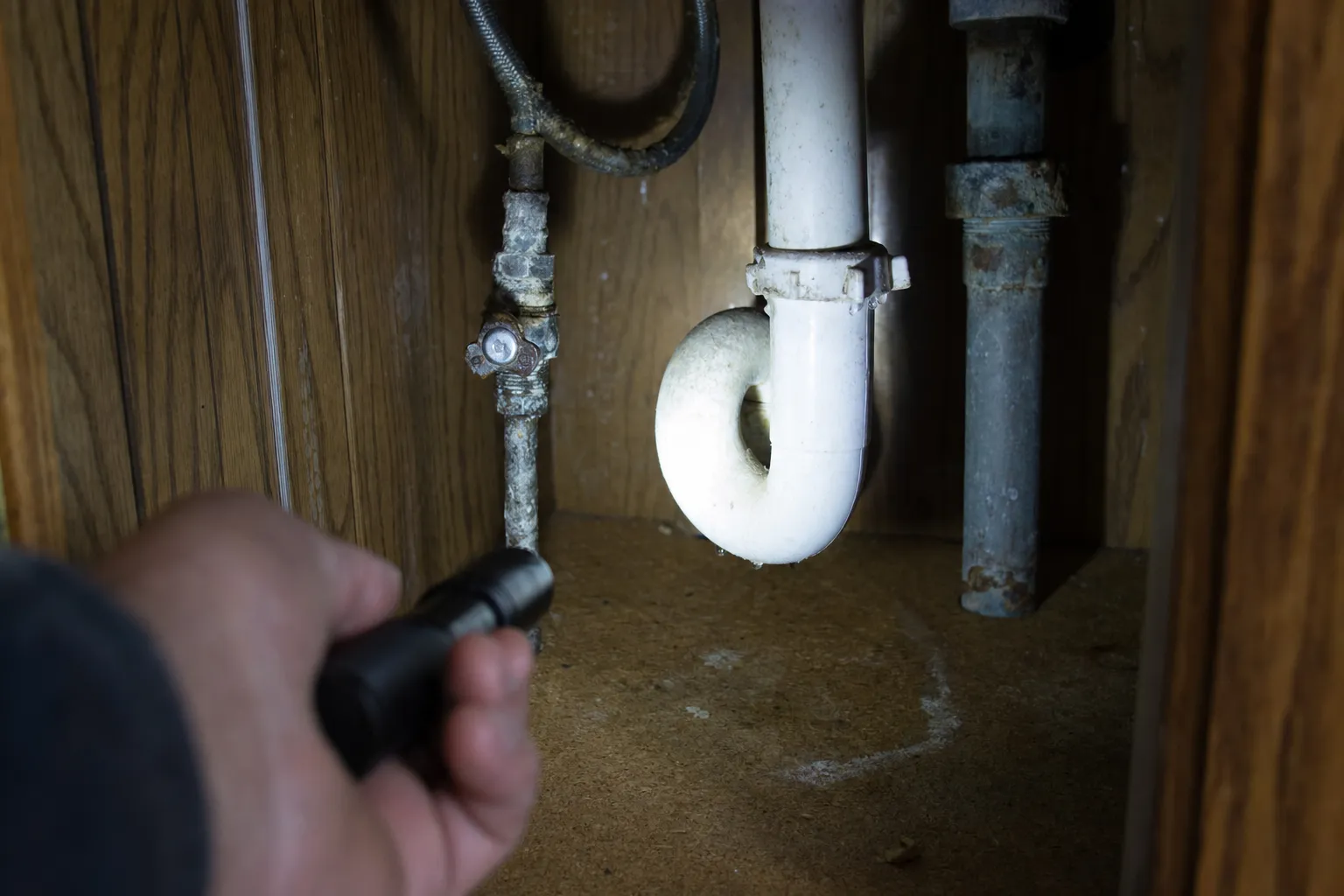
- Stains under a kitchen cabinet: dishwasher supply line, garbage disposal connection, or P-trap joint
- Wall discoloration near a hose bib or exterior wall: frost damage to a supply line that cracked during a cold winter
- Staining along a basement floor-wall joint: hydrostatic pressure or a failing drain tile system
Each of these points to a different repair need, but all of them share one thing: the longer they go without attention, the more material gets involved in the damage.
Why discoloration under a cabinet escalates fast
Cabinet interiors under kitchen and bathroom sinks are warm, enclosed, and rarely inspected. A minor drip at a supply line connection or drain slip joint can run for weeks before a homeowner opens the cabinet for another reason. By then, the particle board floor of the cabinet is usually compromised, and the subfloor beneath it may be softening as well.
A plumbing repair call that addresses the leak early also prevents a flooring repair down the road. The two costs are not even close, and the difference is almost entirely about how quickly the leak gets found.
Ceiling stains in a two-story home
A stain on the first-floor ceiling in a two-story home almost always traces to a bathroom above it. The source could be a toilet wax ring that has lost its seal, a tub or shower supply fitting with a pinhole, or a drain connection that leaks only when that fixture is in heavy use.
The challenge is that the damage accumulates inside the ceiling cavity where it cannot be seen. Staining that appears and then recedes, or that grows slightly after someone showers, confirms an active supply or drain leak above. That is a situation where waiting to schedule a repair creates a worse outcome every week.
How summer storms reveal leaks that were already there
Heavy rain events can overwhelm older drain infrastructure and reveal leaks that were marginal before the additional water pressure. Emergency plumbing problems during Philadelphia summer storms frequently trace back to a crack or joint failure that existed well before the storm hit. If you notice new staining or wet spots in the basement or on walls after a significant rainfall, a pre-existing leak is likely involved.
Your water heater is telling you something
Water heaters give homeowners a clearer set of warning signals than almost any other plumbing component. The problem is that most of those signals get attributed to normal aging, which they are, but normal aging that has crossed a threshold from manageable to urgent.
The average residential water heater lasts eight to twelve years. In Bucks County, hard water accelerates mineral buildup inside the tank, which reduces efficiency and can cause the bottom of the tank to corrode from the inside. When that corrosion progresses far enough, the tank fails suddenly and without any additional warning.
These are the signals worth taking seriously before that happens:
- Rumbling or popping sounds during heating: sediment buildup on the heating element, a sign of significant mineral accumulation
- Rust-colored hot water: the anode rod has depleted and the tank interior is corroding
- Water pooling around the base of the tank: a slow seam leak that will become a full failure
- Consistently inconsistent temperature: a failing thermostat or a heavily scaled element losing heating capacity
- Unit over ten years old with no maintenance history: pressure relief valve and anode rod should be inspected at minimum
Taking those signals seriously early is far less disruptive than addressing them after a tank fails.
Sediment and what it costs you monthly
The U.S. Department of Energy notes that sediment buildup inside a water heater tank forces the unit to work harder and longer to reach the same output temperature, adding measurable cost to monthly energy bills while shortening the unit's remaining lifespan. In Bucks County and the surrounding Philadelphia area, where water hardness is above the national average in many municipalities, flushing a water heater annually makes a real difference. Most homeowners skip this entirely until the tank fails.
When a small leak at the base means full replacement
A water heater that is actively seeping from a seam or the base is not a repair candidate. The tank body itself is compromised, and there is no internal repair for that type of failure. The seepage will progress.
Catching it at the weeping stage rather than at the point of catastrophic failure means the only costs are the unit and the labor to swap it. Waiting until the tank lets go means adding cleanup, drywall replacement, and potentially flooring to that bill. A failing toilet or supply line nearby compounds the water exposure if both fail around the same time in an aging system.
When to consider a tankless upgrade during replacement
If a conventional water heater has reached the end of its service life in a Bucks County home, replacement is an opportunity to evaluate options rather than defaulting to a like-for-like swap. The differences in operational cost, recovery rate, and installation footprint between tankless and traditional water heaters are significant enough to factor into the replacement decision, particularly in homes with high hot-water demand or limited utility space.
Conclusion
Plumbing problems in Bucks County homes rarely arrive without warning. Low water pressure, recurring slow drains, water stains, and water heater signals are all worth acting on before something gives way. The homes in this region carry decades of pipe and sewer infrastructure, and that history means the window between a manageable repair and a major failure is narrower than most homeowners realize.
Catching these warning signs early is consistently less expensive than addressing them after something lets go. A cracked fitting is a repair. A burst supply line inside a finished wall is a restoration project. Root intrusion in a clay sewer line is a camera inspection and a cleaning. A complete sewage backup is a week of work.
If any of these signs sound familiar in your home, do not wait for the situation to escalate. Contact Guaranteed Plumbing & Heating to schedule an inspection and get ahead of the problem before it becomes a bigger one.