


Why is my water heater making noise? Common causes for Philadelphia homeowners
If your water heater has started popping, banging, or rumbling every time it kicks on, you're not imagining things, and you're not alone. It's one of the most common calls we get from homeowners across Philadelphia, and in most cases the noise traces back to sediment that's been quietly building up inside the tank for years.
Philadelphia's water isn't the softest in the country. The city's own water quality reports classify it as moderately hard to hard depending on which treatment plant serves your neighborhood, and that mineral content is exactly what settles at the bottom of a tank over time. Add in row home plumbing that's often decades old, and noisy water heaters show up in almost every corner of the city.
The good news is that a noisy water heater is rarely an emergency the moment you hear it. It's a warning sign, and how you respond to that warning determines whether you're looking at a simple flush or a full replacement. Some noises point to a quick fix. Others mean the tank is already stressed and living on borrowed time.
In this article, you will learn about:
- What kind of noise your water heater is actually making and why
- Why Philadelphia homes see this problem more than most
- What to check yourself before calling a plumber
- Whether the fix is a flush, a repair, or a full replacement
Keep reading to figure out whether that rumbling sound is a five-minute fix or the first sign your water heater is on its way out.
What that noise is actually telling you
Water heaters aren't silent appliances, but they also aren't supposed to sound like something is trying to escape from inside the tank. A soft hum or the occasional tick as metal expands is normal. Popping, banging, knocking, or a steady rumble is your water heater telling you something has changed inside it, and almost every one of those sounds has a specific mechanical cause.
The tricky part is that different noises point to different problems, and treating them all the same way can mean missing something serious. A popping sound and a screeching sound are not the same issue, even though homeowners often lump them together as "my water heater is being loud." Knowing which sound you're actually hearing narrows down the cause fast, and it's worth listening closely for a day or two before you call anyone.
Popping and rumbling: the sediment signature
Popping and rumbling are, by far, the most common water heater complaint we hear from Philadelphia homeowners, and they almost always mean the same thing: sediment has built up at the bottom of the tank. Minerals in your water supply settle and harden over time, forming a layer between the heating element and the water above it.
That layer acts like an insulating blanket. Water trapped underneath it gets superheated, turns to steam, and forces its way up through the sediment in small bursts. Each burst is a pop. Enough of them happening close together sounds like a rumble or a low boil coming from inside the tank, even when no one in the house is running hot water.
- Popping that happens right as the burner or heating element kicks on
- A rumbling sound that continues for a minute or two, then quiets down
- Noise that's gotten gradually louder over the past several months
Banging and knocking: water hammer and loose pipes
Banging or knocking is a different animal from popping. This noise usually comes from the pipes themselves rather than the tank, and it happens when water flow stops suddenly, like when a washing machine valve shuts or a faucet closes fast. The moving water slams into the closed valve and sends a shockwave through the pipe, a phenomenon plumbers call water hammer.
Loose or unsecured pipes make this worse because there's nothing holding them still when that shockwave hits. In older Philadelphia rowhomes, pipe straps loosen over decades of settling, freeze-thaw cycles, and minor vibration, which is exactly the kind of thing that turns an occasional knock into a recurring bang every time someone shuts off a faucet upstairs.
- A valve or faucet closes quickly somewhere in the house
- Moving water inside the pipe has nowhere to go and slams to a stop
- The shockwave travels through the pipe and hits the nearest loose fitting or strap
- That impact produces the bang or knock you hear near the water heater or walls
Screeching, whistling, and hissing: pressure and valve issues
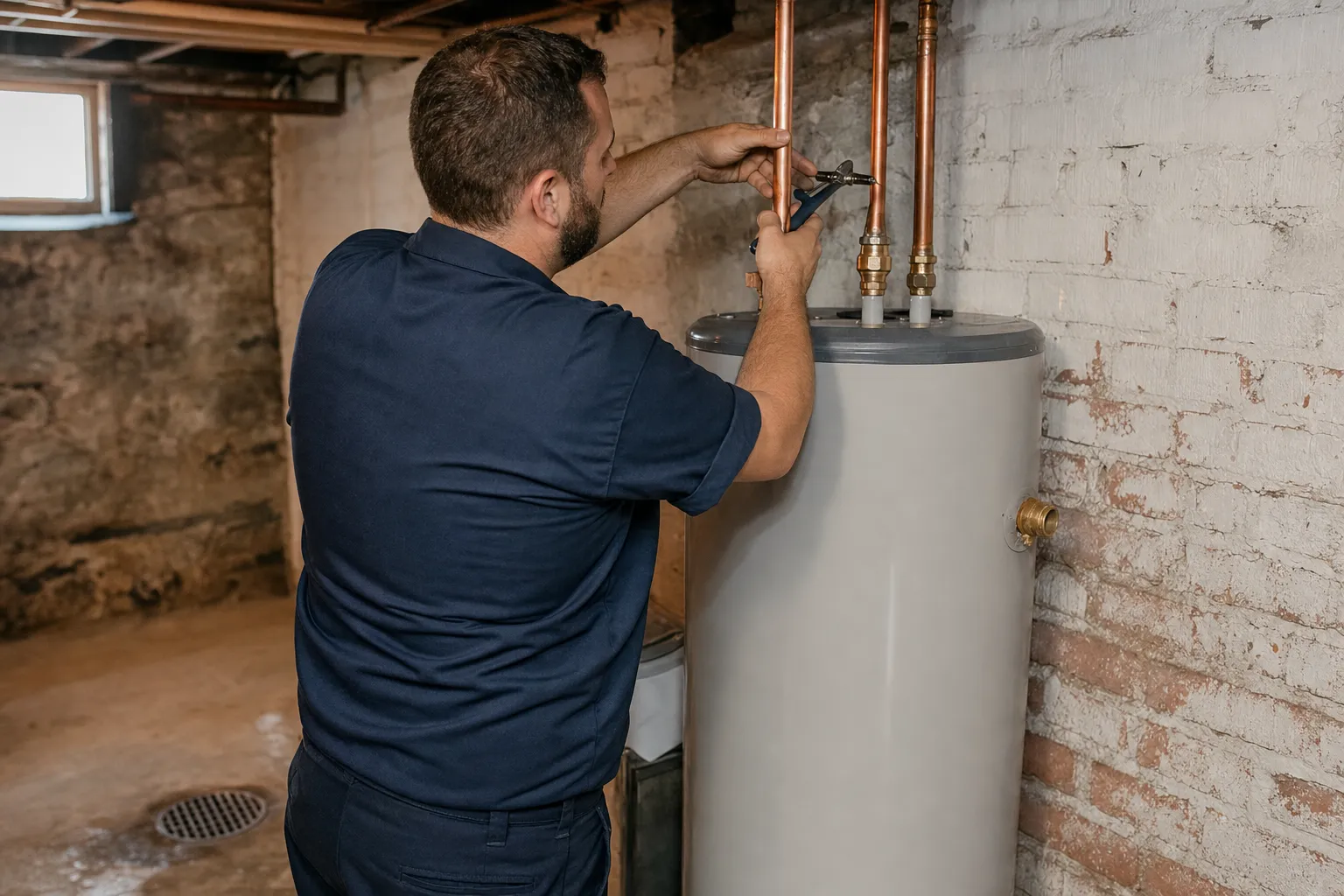
A high-pitched screech or whistle is usually mechanical rather than sediment-related. It's often caused by a partially closed water inlet valve restricting flow, which forces water through a narrow opening and creates that thin, sharp sound. A hissing sound near the top of the tank, on the other hand, is frequently linked to the temperature and pressure relief valve doing its job, releasing a small amount of pressure buildup.
Neither sound is something to ignore, even though they're less common than popping. A whistling inlet valve just needs to be opened fully in most cases, a simple check anyone can do. A hissing relief valve is worth watching closely, since it's the safety mechanism designed to prevent a dangerous pressure buildup inside the tank, and if it's hissing frequently rather than occasionally, that's a sign pressure inside the system is running higher than it should.
Why Philadelphia homes see this problem more than most
Every water heater eventually deals with some mineral buildup, but a few things about Philadelphia specifically make sediment noise show up earlier and more often than it might in other parts of the country. Understanding the local factors helps explain why your neighbor's water heater might be just as loud as yours, even if it's a few years newer.
Philadelphia's water hardness
According to the Philadelphia Water Department, water from the Queen Lane and Belmont treatment plants tests at roughly 120 to 150 parts per million of calcium carbonate, placing it in the "hard" range, while water from the Baxter plant in the Northeast runs closer to 90 to 100 parts per million, considered moderately hard.
Homes served by the Queen Lane and Belmont plants, which cover much of North and West Philadelphia, tend to see higher mineral content than homes closer to the Baxter plant in the Northeast.
That mineral content, mostly calcium and magnesium, is the raw material for sediment. It doesn't matter how well-maintained your water heater is otherwise. If your neighborhood's water runs harder, your tank builds sediment faster than a home across town on a different treatment plant's supply, and the noise tends to show up on a shorter timeline as a result.
- Neighborhoods on the Queen Lane and Belmont systems generally see harder water
- Homes near the Baxter plant in the Northeast tend to see comparatively softer supply
- Hardness can shift seasonally as source water conditions change
Older housing stock and original equipment
Philadelphia's rowhomes and twins are some of the oldest housing stock in the country. The Delaware Valley Regional Planning Commission reports that just over 40 percent of homes in the city were built before 1940, roughly double the share across the broader region. A lot of that housing still runs on plumbing and water heaters that predate current fixtures and standards.
An aging tank that's never been flushed has had years, sometimes over a decade, to accumulate sediment without anyone noticing until the noise starts. Basements and tight utility closets, common in Philly rowhomes, also mean water heaters often sit in spaces where a homeowner rarely looks closely at the unit unless something goes wrong.
- Homes built before 1940 often still have original or unmodified basement layouts
- Tight utility closets in rowhomes make routine inspection easy to skip
- Older water heaters are more likely to have gone years without a flush
Neighborhoods where this shows up most
Combine hard water with original equipment, and it's easy to see why sediment noise becomes such a routine service call in certain corners of the city compared to newer construction elsewhere. We see it constantly in older sections of Fox Chase, Mayfair, and Rhawnhurst, where a large share of the housing stock predates modern plumbing codes entirely.
Newer construction in suburbs like Huntingdon Valley and parts of Bucks County sees the problem too, just later in a unit's life, since hard water eventually builds sediment in any tank regardless of the home's age.
What to check before calling a plumber
Not every noisy water heater needs an emergency visit. There are a few things worth checking on your own first, both to rule out anything urgent and to give your plumber useful information when you do call. None of this requires tools beyond a flashlight and a few minutes.
Start by simply listening for when the noise happens. Does it start the moment the burner or heating element kicks on, or does it happen randomly throughout the day regardless of whether hot water is being used? Timing tells you a lot. Sediment noise is almost always tied to the heating cycle, while water hammer is tied to a valve or faucet closing somewhere in the house.
A quick self-check before you call
- Note whether the noise coincides with the heating cycle or with water use elsewhere in the house
- Check the age of the unit, usually printed on a sticker near the top of the tank
- Look for any visible moisture, rust, or staining around the base
- Confirm the water inlet valve at the top of the tank is fully open, not partially closed
A word on how you use hot water day to day matters here too. Homes running multiple showers back to back, older dishwashers, or a washing machine on the same line as the water heater tend to put more cycles on the unit, which speeds up how quickly sediment noise develops.
When the noise means something more urgent
If you find visible water pooling at the base of the tank, that changes the calculation. A tank that's rumbling and also leaking has likely already suffered internal damage from the stress sediment puts on the metal, and that combination is a much stronger signal to call for service quickly rather than waiting to see if the noise goes away on its own.
A sewer or drain backup happening at the same time as water heater noise is usually a coincidence rather than a connected issue, but it's still worth mentioning to your plumber when you call, since it can point to a broader issue with the home's plumbing system that's worth addressing together.
What to have ready when you call
- The age of the unit and whether it's gas or electric
- When the noise started and whether it's gotten louder
- Whether you've noticed any moisture, rust, or a drop in hot water pressure
- Whether the noise happens on a schedule or seems random
Having these details ready means your plumber can often tell you over the phone whether this looks like a same-day fix or something that needs a closer look in person.
Fixing it: flushing, repair, or replacement
Once you know what's causing the noise, the next question is what to actually do about it. The right answer depends on the age of the unit, how long the noise has been going on, and whether there's any visible damage alongside the sound. Most water heaters fall into one of three paths from here.
When a flush solves the problem
For a unit that's a few years old with mild, recent sediment noise, flushing the tank is often enough to quiet things down and restore efficiency. The process involves draining the tank to remove accumulated sediment, then refilling it. It's a straightforward maintenance task, and for many homeowners it resolves the popping and rumbling completely, at least for a while.
The catch is that once sediment has hardened into a thick, packed layer at the bottom of an older tank, a standard flush may only remove the loose material on top, leaving the hardened base behind. A flush works best as a preventive step on a newer unit rather than a fix on a tank that's gone many years without one.
- Draining the tank fully removes loose sediment sitting on top of the layer
- A flush restores efficiency and typically quiets the popping noise
- Annual flushing on hard water systems prevents the layer from hardening in the first place
When it's a repair, not a replacement
Some noises don't require replacing the whole unit. A whistling inlet valve, a loose heating element, or a relief valve that needs adjustment or replacement are all repairs, not full system failures. These fixes are typically quick, and they're worth pursuing before assuming the entire water heater is at the end of its life.
- A partially closed or faulty inlet valve causing whistling
- A loose or failing heating element causing a buzzing or humming sound
- A relief valve that's hissing more than expected due to a pressure issue
When replacement makes more sense
Water heating typically accounts for up to 20 percent of a home's energy use according to the U.S. Department of Energy, making it the second-highest driver of energy expenses after heating and cooling. An inefficient, sediment-choked unit isn't just noisy, it's quietly raising your utility bill every month it stays in service. When a tank is older, has been rumbling for a long time, or shows any sign of rust or moisture at the base, that combination usually points toward replacement.
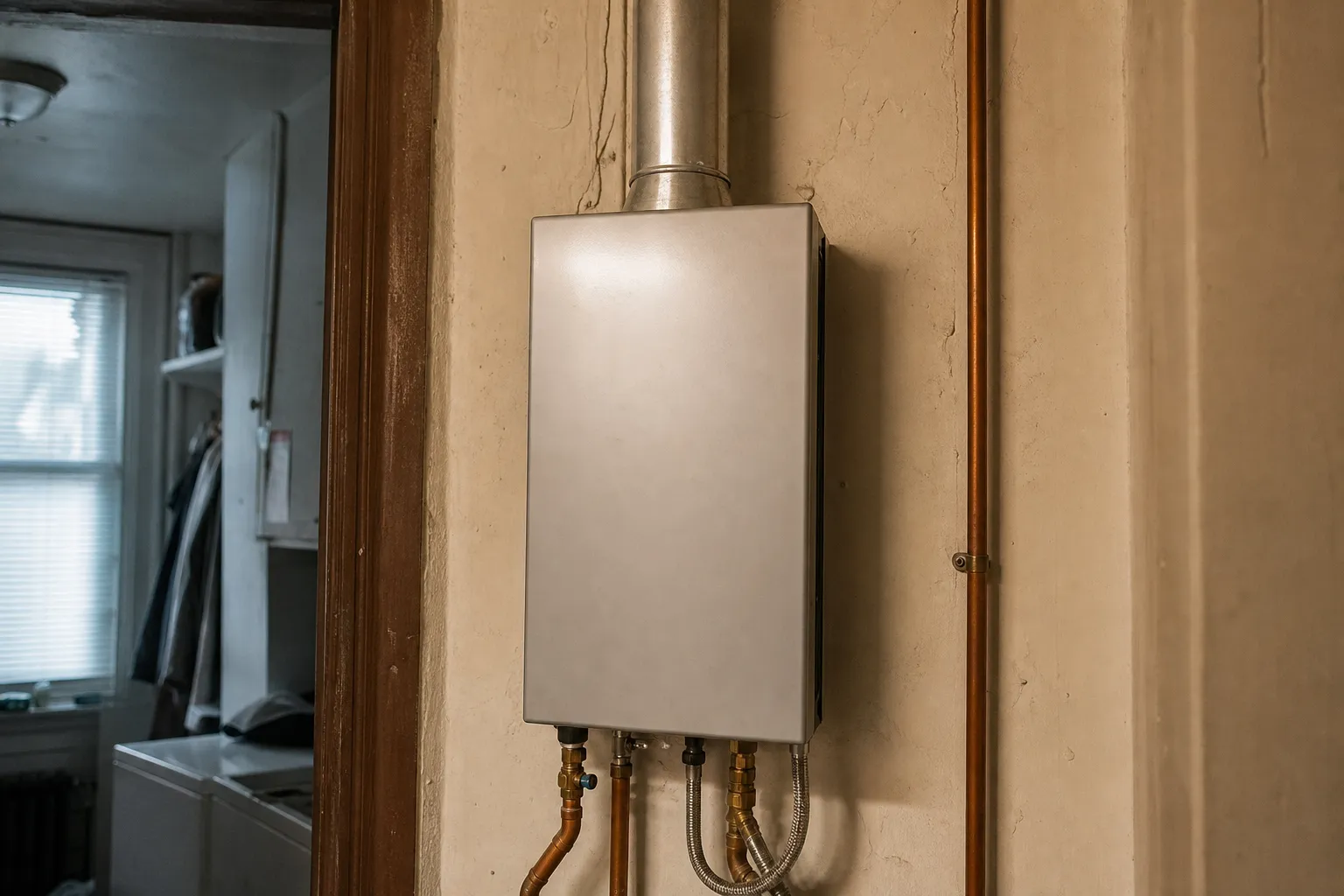
At that point, comparing tankless and traditional water heaters is worth doing before you decide, since a tankless system changes the sediment equation by design, and reviewing what a water heater replacement typically costs in Philadelphia can help set expectations before a plumber even arrives.
- Unit is under roughly six years old with recent, mild noise: flush and monitor
- Unit is mid-life with persistent noise but no leaks: flush, then reassess if noise returns quickly
- Unit is aging with heavy, long-standing noise and no leaks: repair the specific issue found, or discuss replacement timing
- Unit shows noise plus any moisture, rust, or corrosion: replacement is usually the safer, more cost-effective path
Sediment that's been left untouched for years can also mean internal tank damage that a flush can't reverse. In those cases, spending money on a flush or minor repair only delays an inevitable replacement, and the noise typically returns within weeks.
Conclusion
A noisy water heater is one of those problems that's easy to put off, mostly because the house still has hot water and nothing seems broken yet. But the popping, banging, or rumbling you're hearing is real information about what's happening inside that tank, and in a city with water as hard as Philadelphia's, that information tends to matter sooner rather than later.
The difference between a five-minute flush and a full replacement usually comes down to how long the sediment has been sitting there and whether the tank has any other signs of stress alongside the noise. Catching it early, while it's still just an annoying sound and not a leak, is almost always the cheaper and less disruptive path.
If your water heater has started making noise, don't wait for it to get worse. Contact Guaranteed Plumbing and we'll take a look, flush it if that's all it needs, and give you a straight answer on whether repair or replacement makes more sense for your home.